–

–
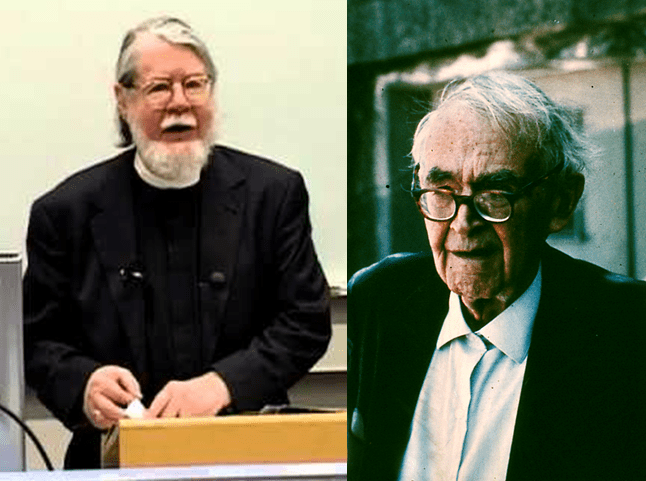
Robert Jenson was a masterful theologian who sought to think within the bounds of theologia and, within those bounds, to receive the Christian tradition in fresh if unorthodox ways. He writes this awesome statement: “This is sometimes the way of theology: to take a plain phenomenon of the gospel’s narrative that causes difficulty in certain conceptual connections and remove the difficulties by adjusting not the narrative but the connections.”[1] That was Jenson’s tendency: to adjust the form, not the content, of the Christian gospel, and so make it intelligible to contemporary ears.
My last post on Robert Jenson went over Jenson’s problems with the ancient ontological foundations of classical Christian doctrine. In his writings, he sought to overturn these foundations by substituting their Aristotelian or platonic makeup with that of Hegel. This substitution led him to criticize the ancient way of understanding divinity as simple, timeless and changeless, and to uphold a doctrine of divinity where God’s being is nothing other than event. The function of God’s being-as-event is to disallow any speech about God where God can be identified with anyone other than the God revealed and acted out as Jesus Christ, His Father, and His Spirit. For something or someone to be God means that He is this event: this biblical, Triune God-event.
For God’s being-as-event to be the interplay of Jesus, the Father, and the Spirit is for ontology itself to be constituted by eventfulness, and not by the prior abstracted reality of “being.” This poses obvious problems for the classical doctrine of simplicity. If God is not simple, and ontology is eventfulness, then how can the three – Father, Son, Spirit – be said to be “one God”? This is where my claim that Jenson’s explications nevertheless retain the content, if not the form, of Christian doctrine is proved true.
ST: The Oneness of the Three
Jenson writes, “Since the Lord’s self-identity is constituted in dramatic coherence, it is established not from the beginning but from the end, not at birth but at death, not in persistence but in anticipation. The biblical God is not eternally himself in that he persistently instantiates a beginning in which he already is all he ever will be; he is eternally himself in that he unrestrictedly anticipates an end in which he will be all he ever could be.”[2]
Here, Jenson is functioning on a definition of eternity as a time-bound reality. Eternity is not, as the classical thinkers say, a separate realm in which God lives in his essence. Eternity is rather that happening, that “dramatic coherence” Jenson calls it, where all that is theologically united lives, moves, and has its being. Eternity is that time where God and man live in harmonious ekstasis. In other words, eternity is that time where Father, Son, and Holy Spirit live as one God. How Jenson grounds these concepts, like I said, is not in some “before-ness,” some realm that is prior to the actual happening of God’s-being-one, but in “after-ness,” in the eternal realm of “anticipation,” where Father, Son, and Holy Spirit will be fully and completely the Triune God of Scripture in the unity of the Eschaton. It is the Eschaton that provides the glue that holds the whole scriptural reality – including the God at the center of that reality – together.
Jenson continues, “The triune God’s eternity is precisely the infinity of the life that the Son, who is Jesus the Christ, lives with his Father in their Spirit… About how God could as the same God have been other than Jesus the Son and his Father and their Spirit, or about what that would have been like, we can know or guess nothing whatsoever.”[3]
The Christian is not to think of eternity as a timeless void separated from the goings-on of this world, but as the flesh-and-blood life of Jesus Christ, the Hebrew preacher of first century Palestine, who, in calling the God of Israel his Father, was the Son spoken about in the Spirit-inspired Scriptures. This is what it means for God to be Trinity.
ST: The Spirit of the Future
For the Eschaton to be the place of God’s unity is for the Holy Spirit to so make it. The eschatological glue that holds things in God together, according to Jenson, can really be posited as a function of the Holy Spirit’s economia. It is the Spirit’s function to make true the reality that Jesus Christ and His Father are the one God of Scripture. It is the Spirit’s role to make true that which is believed by faith, that the Father, Son, and Spirit are one God.
Here is Jenson again: “The Spirit is the Liveliness of the divine life because he is the Power of the divine future. He is the one who, when he in time gives a ‘down payment’ on the Kingdom, gives precisely himself.”[4] The Spirit and the Eschaton, to Jenson, are never to be thought about as separated from each other precisely because as the agent of the future, the Spirit is. It is when the Church participates in the Eschaton – which, to Jenson probably amounts to what happens during the Sunday liturgy – that the Spirit is truly and fully present as the Spirit of the Lord Jesus Christ and His Father.
We will end this post with one last quote:
“The biblical God’s eternity is his temporal infinity… What he transcends is not the having of beginnings and goals and reconciliations, but any personal limitation in having form… The true God is not eternal because he lacks time, but because he takes time… God is not eternal in that he adamantly remains as he began, but in that he always creatively opens to what he will be; not in that he hands on, but in that he gives and receives; not in that he perfectly persists, but in that he perfectly anticipates… The dominating theological enterprise of the century, Karl Barth’s Kirkliche Dogmatik, has thus at its heart the drastic proposition with which we began: ‘God’s deity, into its furthest depths, consists therein… that it is event… The fundamental statement of God’s being is therefore: God is what happens between Jesus and his Father in their Spirit.”[5]
Soli Deo Gloria
[1] Robert Jenson, Systematic Theology, Vol. I: The Triune God (Oxford, UK: Oxford University Press, 1997), 124.
[2] Robert Jenson, Systematic Theology, Vol. I: The Triune God (Oxford, UK: Oxford University Press, 1997), 66.
[3] Robert Jenson, Systematic Theology, Vol. I: The Triune God (Oxford, UK: Oxford University Press, 1997), 141.
[4] Robert Jenson, Systematic Theology, Vol. I: The Triune God (Oxford, UK: Oxford University Press, 1997), 157.
[5] Robert Jenson, Systematic Theology, Vol. I: The Triune God (Oxford, UK: Oxford University Press, 1997), 217-221.

 Alex Renner's Blog