My last few posts have been straightforward about my growing conviction that to be Anglican is to be Reformed; that is, in the magisterial Protestant sort of way, drawing its inspiration from the figurehead Reformed leaders of a Calvin, Bucer, Zwingli, and the like. To read the 39 Articles should leave you thinking the same thing.[1] But to be Reformed in the Anglican way is slightly different than to be so in the way other Reformed churches have been and are. How so?
Let’s open up the Articles[2] and see how they present themselves.
Though most of the Articles have a sort of (negative) Anti-Roman flair, of particular interest for drawing out their (positive) Protestant character are Articles VI, XI, XII, XXV, IXXX, XXXI.
Drawn up as a list of analytic propositions, these Articles (constitutive of Anglican belief, mind you) could be put thus:
VI: All that is necessary for salvation and true spirituality is only and exclusively found within the Holy Scriptures of the Old and New Testaments. XI: Justification, or right standing before God, is to be found only by faithin the objective and finished work of Jesus Christ. XII: Good works are not meritorious to our salvation, but are only to be conceived as springing forth from a pre-existent faith. XXV: The only sacraments that act as instruments of grace (i.e., those that are rightly called sacraments) are those of the Lord’s Supper and Baptism. IXXX: The sacrament of the Lord’s Supper is of such a nature that those who do not have faith in Christ do not truly receive the realitiescontained in the signs of bread and wine. XXXI: The exclusive instrument for the satisfaction of God and the reconciliation of God and Man, effectual exclusively for the salvation of mankind, is that made by Jesus Christ. There neither is nor can be any propitiatory activity outside of his life and work alone.
Other propositions with Article-support:
Ecumenical councils can err and sometimes have erred.
The various historic churches (Antioch, Jerusalem, Rome) can err and have erred.
Purgatory, or any sort of purgative intermediate dimension after death, is a fiction, unsupported by the Scriptures.
Prayer to anyone or anything other than to the Triune God is unsupported by the Scriptures and a danger to a healthy spirituality.
The Lord’s Supper does not contain the presence of Christ in a corporeal sense (see IXXX).
The nature of man, after the fall, is adequately called totally depraved.
Because of said depraved nature, the salvation of man, both in general and in particular, is always exclusively due to God’s initiatory activity in both predestination and election.
As one considers these propositions, it is clear that the picture that emerges tightens the field of what can be defined as Anglican identity. If the Thirty-Nine Articles are to be upheld (understood, remember, according to their literal and grammatical sense) as essential theological statements of Anglican belief, then these Reformed commitments must be in play.
Yet, there are also ways in which the Articles (as well as the Books of Homilies, the other authoritative Anglican theological document besides the Scriptures and the Prayer Book) might nuance this strong push I am making here for the “Reformed” character of Anglican identity. For one, many of those who hold to traditional Reformed theology list out the “five points” as summative of the broad commitments contained in the Reformed tradition. This isn’t always the case, of course, and there are important nuances to be highlighted. Yet, when reading the authoritative Anglican documents, one sees that it is not a requirement, for example, to hold to “particular redemption,” nor to “perseverance of the saints” (the latter of which is almost explicitly rejected in the Homily “A Sermon How Dangerous a Thing it is to Fall from God,” in book one of the Book of Homilies). When considered in comparison to a fold like the Lutherans, who also take issue with those two points, these facts give one the impression that to be Anglican is to be somewhere, roughly, between the two; Lutheran and Reformed, that is.
Anglicans don’t believe in the corporeal presence like Lutherans do, nor the ubiquity of Christ’s human nature, yet they would find room in the Anglican documents for rejecting both the “once saved always saved” formula as well as the limited atonement doctrine of the Reformed, and in that way would be like the Lutheran fold. Anglicans reject purgatory, adoration and invocation of the saints, meritorious charity unto salvation, and hold to original sin, total depravity, predestination and election, the mystical or spiritual presence of Christ in the Supper (alongside a general “receptionist” understanding), justification by faith alone, sola scriptura, and a general efficacy/applicability of the atonement.
Now, these are all points theological, and not necessarily indicative of any one necessary liturgical style. The liturgical rituals are not unimportant or disconnected from the doctrine (lex orandi lex credendi), but are not essentially connected to one version of churchmanship over another. That is something for the church to hash out and about which to converse.
Such it seems to me.
Soli Deo Gloria
[1] Many Anglican statements of belief today will claim to hold to the “literal and grammatical sense” of the Articles, thereby attempting to make this clearer, one would hope. See To Be a Christian: An Anglican Catechism (Wheaton, IL: Crossway, 2020), 133.
[2] The authorized version of the Book of Common Prayer (for most Anglican churches) is the 1662 version, which includes in it the Articles of Religion.
Davenant Press, a few years ago, published a small translation of Richard Hooker’s Laws of Ecclesiastical Polity, book V, dedicated to Christology and the Sacraments. In it, Hooker lays out the English Church’s position on the two natures of Christ and their interrelation.
It is clear, as you read these portions, that Hooker is speaking on a topic which has its foundation in the fundamental divide separating the Lutheran and Reformed communions, and he explicitly takes the side of the Reformed theologians on many topics, even as he does so in an ecumenical tone.
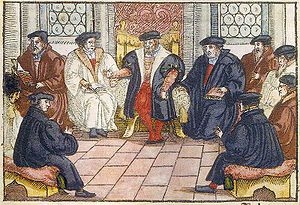
For those unfamiliar: a Rubicon moment during the early Reformation period is known as the Marburg Colloquy, participated in by representatives of the Lutheran and Reformed churches (Luther/Zwingli). This meeting had to do with how the Protestant churches were going to understand the presence of Christ in Holy Communion. Everyone agreed that the Roman doctrine of transubstantiation was off the table; that was clearly “repugnant to the Word of God.” Yet, there still existed major disagreement when it came down to the niceties of Christ’s presence in the sacrament. For Luther, Christ “just is” present in the sacrament, as long as the Word of God is spoken over the sacrament (“This is my Body”). He is bodily, corporeally (if you like), there. What that really “means” as far as philosophical explanation is beside the point and frankly unhelpful (an attempt in this direction is exactly what led to the doctrine of transubstantiation, in Luther’s opinion). For the Reformed, however, this wasn’t the case. Must Christ’s words of institution really be taken in such a literal way? And, further, what did that mean, then, to say that Christ has “ascended into heaven, and is seated at the right hand of the Father”? What did that mean for our understanding of Christ’s flesh? If Christ is bodily present in the Supper, did not that contradict this universal belief expressed in the Creed?
Well, in response to these questions, the Lutherans posited what came to be known as the genus Majesticum, that the attributes natural to the divine nature are communicated to or infused into the human nature when the Logos takes flesh in Jesus. Crucially, this was a one-way communication. Nothing like this communication happened in the reverse order (only divine—>human, not human—>divine). And this precipitated an ages long debate about just what constitutes human nature, what is, in fact, essential to it. For the Reformed, locality is an essential property of any instantiation of human nature. You cannot have a human if that human is not locally (i.e., spacially or corporeally) present. There is no body if that body does not have a definite place. For the Lutherans, however, who never officially denied this conviction about locality, they emphasized that any real commitment to what they called “the whole Christ” must include being able to affirm the theological sentence: “wherever the divinity of Christ is, the humanity must also be” (or something closely akin to this). The Lutherans weren’t convinced the Reformed could really subscribe to this, seeing as their theologians spoke in terms that constantly communicated what I will call the “endurance of natures”: the divinity does the divine thing, and the humanity does the human thing. Any communication in the way the Lutherans were outlining seemed to them to destroy the integrity of the natures. How could a human nature, in other words, be omnipresent, and—crucially—continue being what we understand to be human nature? And hence the situation up to this day: the Lutherans accuse the Reformed of being Nestorian in their strict distinction of the natures, and the Reformed accuse the Lutherans of being Eutychian[1] for emphasizing the communication of divine attributes to the human nature.
My interest in all of this stemmed from reading Christopher Beeley’s review of Rowan Williams’ Christ: The Heart of Creation. In that review, he makes a crucial distinction as it relates to this whole conversation: that the divine nature just is the three hypostases of the Trinity. If that is the case, then there can be no abstraction between the hypostasis of the Logos and the divine nature as such, and therefore the Lutherans are correct. This is because if the divine nature truly is without qualification the three hypostases, and nothing divine can be communicated to the human nature as the Reformed posit, then you really do have some form of adoptionist/Nestorian schema (with the divine and human natures containing separate hypostases themselves). That strict division really matters. I can perhaps see a Reformed saying in response that for the attributes to be communicated is a different thing then for the hypostasis to be realized in the human flesh, but I don’t see how this follows if anything like a traditional commitment to divine simplicity is held. If the Reformed want to say what they say about the inability of natures to hold a real communication in the way the Lutherans outline, then the hypostasis must in some sense be external (at least in thought) to the divine nature. The Reformed tendency to posit a model of the Hypostatic Union which speaks in very modal terms (“the hypostasis does divine things in His divine mode while He does human things in His human mode”), though not without patristic precedent, assumes that the hypostasis can somehow be conceived as something other than the divine nature, full stop. Almost like it is a third thing which participates in two other separate things. And so the divine hypostasis of the Son in some sense cannot be fully equated with the divine nature, if the Reformed conception is right. If you believe that Christ’s humanity can receive divine attributes as part of what it means for human flesh to be really assumed by the Logos, and you believe that the divine nature just is the subsistence of the three hypostases, then you are on the Lutheran side. If the hypostasis can be abstracted from the divine and human natures, and don’t believe such a communication can occur without destroying the integrity of the human nature, then you are on the Reformed side. Whether or not one side or the other is true is beside the point. It is important for this entire conversation.
Perhaps the Lutheran model of the union could look like this:
The Lutheran Communicatio. Proud of myself for this one…
Notice the one-directional movement of the communication and the unity between hypostasis and nature in the first circle. And notice, too, the absence of a unique and distinct hypostasis in the second.
A Reformed model, in contrast, might go as follows:
The Reformed Communicatio. The crappy one (according to Luther).
Notice, here, that the hypostasis has been abstracted from the divine nature, separately conceived, and there is no communication or infusion of attributes between the natures.
One thing to note is the correctly-calibrated instinct that the theologians of the Reformation held regarding ubiquity and sacramental presence. The linchpin, to my mind, for a real presence (by which I mean “corporeal” or bodily presence) in the sacrament is the genus Majesticum. If the humanity of Christ has been infused with divine properties following the union, and the body of Christ can therefore be present physically in multiple places at once, then Christ “can” be present bodily at the Table. If such a communication has not taken place, however, then such cannot be so, except in a “heavenly, spiritual manner,” as the Reformed claim (which, to me, is centered not on the elements so much as the person receiving).
What does this have to do with the “Search for Anglican Sacramental Presence”? To finally bring Hooker back in, he seems to want to affirm something more akin to the latter model: “[There is no] mutual infusion of the sort that would really cause the same natural operations or properties to become common to both. Whatever is natural to Christ’s deity remains uncommunicated [!] to his manhood.”[2] He then writes that “between the two natures there is often a cooperation, always an association, but never any mutual participation by which the properties of one are infused into the other.”[3] Utterly. Reformed.
My underlying motivation in researching most of this is my continual search for a specifically Anglican position on things like Christology and sacramental theology. This stems from my utter refusal to accept the “broad tent” caricature that is very much in vogue concerning the confessional position of Anglicans. My simple take on the way to approach this is something like: the early figureheads of the English Reformation, or, at least, the agreed-upon theological figureheads of the Anglican church, as well as the Articles and the Books of Homilies, should be considered authoritative in regards to the official Anglican position on doctrinal matters. From this, I conclude that for Hooker to express what seems unambiguously to be the Reformed position on the issue of Christ’s ubiquity is for the Anglican position to therefore be much more akin to the Reformed model above, and hence not on the side of the Genus Majesticum.[4]
I might be wrong about this, but, also taking into account the Thirty-Nine Articles—which, admittedly, does not address the specific issue of ubiquity but does claim that “The Body of Christ is given, taken, and eaten, in the Supper, only after an heavenly and spiritual manner. And the mean whereby the Body of Christ is received and eaten in the Supper is Faith”—the Anglican position on these matters seems unquestionably Reformed. That is, if the principal documents and theologians stemming directly from the English Church’s departure from Rome are to be believed. The preface to the volume in question puts it like this: “Although Hooker has sometimes been misunderstood or misrepresented on this point, a careful reading of Chapters 54-55 in the context of sixteenth-century debates shows him siding resolutely with the Reformed position, although he seeks to frame it as irenically as possible. Finally, there is no point in obscuring the fact that Hooker’s eucharistic theology is unambiguously receptionist [that is, that the real change of the eucharist is in the receiver, not the elements themselves].”[5]
I am not necessarily happy about any of this. There is an innumerable amount of Anglican churches which very much contradict this in their theology and practice. This is just how it seems to me. If you are Anglican, then it seems the position of your Church is to reject the Genus Majesticum, to hold that it is possible for the hypostasis to be conceived separately from the divine and human natures, and therefore for the sacrament to hold a “heavenly, spiritual” presence, and not a “real” (bodily) presence. I don’t suppose this will change anyone’s mind, but it does seem to me to be the case.
Soli Deo Gloria
[1] The Eutychian heresy taught that the human nature of Christ was overwhelmed and compromised by the divine nature following the assumption of human nature by the Logos. The line, in other words, between human and divine natures became blurred when God took on flesh.
[2] Richard Hooker, The Word Made Flesh For Us: A Treatise on Christology & the Sacraments from Hooker’s Laws, ed. by Brad Littlejohn & Patrick Timmis with Brian Marr (Landrum, SC: Davenant Press, 2024), 17.
[3] Richard Hooker, The Word Made Flesh For Us: A Treatise on Christology & the Sacraments from Hooker’s Laws, ed. by Brad Littlejohn & Patrick Timmis with Brian Marr (Landrum, SC: Davenant Press, 2024), 21.
[4] It is worthy of note that Peter Martyr Vermigli, the Italian Reformed theologian, dedicated his Dialogue on the Two Natures of Christ to John Jewel, the English bishop, whom he also praises as someone who rejects the doctrine of ubiquity.
[5] Richard Hooker, The Word Made Flesh For Us: A Treatise on Christology & the Sacraments from Hooker’s Laws, ed. by Brad Littlejohn & Patrick Timmis with Brian Marr (Landrum, SC: Davenant Press, 2024), xxxiv.
On my old Wix blog, I would post poems I had written every once in a while. Well, my journal has seen an uptick in the amount of poems written in it for the last few weeks so I felt I would share one here.
—-
Language, words, are a railroaded track of love, comfort, or terror, Harboring or harvesting the mind’s thick-bodied stores, Able to glorify, magnify, fright, or infiltrate, and balm, bleed, bore, or blaze our beings-in-the-world. I give myself wholeheartedly to the Word in the beginning. To lay down those tracks make you a skilled or lazy wizard, a spinner of speaking whose products can be handed out to heal the rough and tumble of a life spent sorrowing. But to be a skilled forger of phrases can paint the pretty leaves purple again; as in, reimbue life with a radiant raising of religious roofing.