Doctrine

The Son of the Father: T.F. Torrance on the Divinity of Jesus

T.F. Torrance is one of those theologians you can confidently say is a pretty homogenous writer when his whole corpus is considered. If you have read one of his books on theology – unless it is a highly specific monograph or journal article or something of the sort – you have read them all. This is not to be disparaging of Torrance’s work; he is one of my favorite theologians to learn and glean from. In fact, his sort of repetitive, lets-circle-back writing style fits in with his own theory of language and human understanding. For those who have read a good bit of his output, however, the thought can very well cross your mind when you approach a section you have read two or three times over elsewhere that, “He’s saying this again? Well alright…” Regardless of this aspect, his ideas are meaty and worth wrestling with.

Currently I am reading (for the first time) his Mediation of Christ, the book many veterans of Torrance commend to the newly-interested as the ideal starting place. Torrance has already mentioned Israel’s place in salvation history, Einstein, “onto-relations,” and the conceptual revolution he is convinced is taking hold in the Western world – all topics that fall into the “over-and-over” category – and is making his way to a treatment of Christology proper.

The Christology never gets old, though. Ask any regular reader of Torrance and they will tell you that coming away from sustained attention to his Christological and Trinitarian reflections makes you want to run to Church and perform a praise break. He writes in such a way as to lead his readers to a greater love and affection for the Lord Who has loved them in His own Person. He wants people to praise Jesus, and so he writes to fan the flames of his readers’ hearts.

Let us take his chapter, “The Person of the Mediator,” as an example. Here he lays out the importance of the Christian affirmation that Jesus Christ is “God of God, Light from Light,” i.e., just as much God as the Father is God. He says,

“The Sonship embodied in Jesus Christ belongs to the inner relations of God’s own eternal Being, so that when Jesus Christ reveals God the Father to us through himself the only begotten Son, he gives us access to knowledge of God in some measure as he is in himself… Jesus Christ is Son of God in a unique sense, for he is Son of God within God, so that what he is and does as Son of the Father falls within the eternal Being of the Godhead… Jesus Christ is to be acknowledged as God in the same sense as the Father is acknowledged as God, for it is in virtue of his Deity that his saving work as man has its validity.”[1]

Pretty solid, yet standard, Christian language concerning the Divinity of Jesus. So far, so good. Torrance is never content to simply state the official doctrinal language established by the historic Church, however; he is always looking to drive home the pastoral import of these traditional ways of speaking of God and Christ. So, of course, he continues:

“He [Jesus] does not mediate a revelation or a reconciliation that is other than what he is, as though he were only the agent or instrument of that mediation to mankind. He embodies what He mediates in himself, for what he mediates and what he is are one and the same. He constitutes in his own incarnate Person the content and the reality of what he mediates in both revelation and reconciliation.”[2]

Alrighty! So now Torrance is speaking to a question that the average, everyday Christian very well comes in contact with: Who (or what) does Jesus reveal? Himself! Torrance says. There is no reality or God apart from whom Jesus means to point us, since Jesus Himself “constitutes” that God we would look for elsewhere. It is God, in other words, who is on display in Jesus. It is God who heals the blind and cleanses the lepers; it is God who lifts up the poor from the dirt and gives them dignity as persons; it is the Holy One of Israel who condescends as a baby to unite us with Himself. Jesus is Himself the content of His own revelation. Jesus is Himself our salvation, and not simply the one Who points to it, as if it was something other than His very Person.

It gets even deeper, though. What are the consequences of holding a different opinion other than the one just expressed? What if Jesus really does point away from Himself to another reality, another thing called “salvation”? What if Jesus is not Himself God?

“If you cut the bond of being between Jesus Christ and God, then you relegate Jesus Christ entirely to the sphere of creaturely being, in which case his word of forgiveness is merely the word of one creature to another which may express a kindly sentiment but actually does nothing… To claim that Jesus Christ is not God himself become man for us and our salvation, is equivalent to saying that God does not love us to the uttermost, that he does not love us to the extent of committing himself to becoming man and uniting himself with us in the Incarnation… If there is not unbreakable bond of being between Jesus Christ and God, then we are left with a dark inscrutable Deity behind the back of Jesus Christ of whom we can only be terrified. If there is no relation of mutual knowing and being and loving between the incarnate Son and the Father, then Jesus Christ does not go bail, as it were, for God, nor does he provide for us any guarantee in what he was or said or did as to what God is like in himself.”[3]

If Jesus Christ is not the Holy One of Israel, if He is not Himself God, then he is just a creature sending peace and blessing to us, ourselves creatures like him. We might could find a certain moralistic lesson in this, something close to an exemplarist religion where each person is trying his best to correspond himself to the good life, but we would still be in the dark about God. That is what Arius believed, and what current-day proponents of his thought still believe about God. If Jesus is not God, we would still have to guess at the character of the God who he supposedly represents. We would still have to guess whether, at the end of the day and regardless of the many assurances to the contrary, God is not actually just a sky-tyrant whose sole desire is to see humanity suffer and die. There would be no way of knowing this isn’t the case if Jesus is not Himself God.

And why is this? Why does Jesus have to be God for us to know the character of God? Because what Christians claim – what Jesus claimed about Himself – is that Jesus is God come to us as man. He is God, crossed over the divide of being onto our side of things. He is the God stepped from behind the curtain. He has said, “Here I am.”

Furthermore, the Bible’s portrayal of Jesus is one whose delight is in the restoration of people. Everywhere he goes, the Bible tells us, Jesus seeks to heal, restore, and bring to life that which has been destroyed by sin and death. God is good, life-giving, and holy, we know, because Jesus is good, life-giving, and holy.

And thank the Lord that that is true. Thank Jesus (!) that we do not have to guess about who He truly is, but we can rest in His blessed character shown not only among the poor and the widowed and the sick, but upon the cross, where the depths of divine love are on absolute full display.

Soli Deo Gloria


[1] T.F. Torrance, The Mediation of Christ (Grand Rapids, MI: Eerdmans Publishing Company, 1983), 64.

[2] T.F. Torrance, The Mediation of Christ (Grand Rapids, MI: Eerdmans Publishing Company, 1983), 67.

[3] T.F. Torrance, The Mediation of Christ (Grand Rapids, MI: Eerdmans Publishing Company, 1983), 68-70.

Doctrine

The Scriptural Christ is the True Christ

There are many Jesus Christs that roam this world. There is the Muslim Christ – the one who did not die on the cross, who paved the way for Muhammad, who taught profoundly of a god; there is the Buddhist Christ, the person whose teachings pointed to the self-negation at the heart of true wisdom; there is the Republican Christ, the Christ whose sole passion is for the rights of individuals to forge their own path in life, who looks with favor on the American capitalist state and its democratic structures; there is the Liberal Christ, whose definition of love is something like self-actualization, self-care, self-liberation. There is even the Modernist Christ, the first-century Jewish man whose perfect God-consciousness helped the rest of humanity cultivate their own God-consciousnesses. This one even changed the face of the political, social, and economic state of the ancient world, and was a great moral teacher.

And then there is the Scriptural Christ. Or, in other words, the biblical Christ, the one whom the Christian Church worships. This Christ is the one for whom and through whom all exists (Col. 1), the Word made flesh who dwelt among us, who was God and was with God in the beginning (John 1), the one whose Spirit cries out “Abba, Father” within the hearts of Christians and groans with groans too deep for words (Rom. 8), the one whose sorrowful Passion propitiated the sins of the entire world (Isa. 53), the one who fulfills his own teachings about Blessedness with perfect consistency (Matt. 5), the one whose righteousness justifies and unites us with Himself by faith (Rom. 5-6), the one who is love (1 John), the one whose flesh and blood men and women must eat in order to have eternal life (John 6), the one who chose to empty himself and take on the form of a servant, forfeiting his privilege as the Son of God (Phil. 2), the one who entered the world alongside the Spirit to form the world from the waters of chaos (Gen. 1), and the one who has made peace by the blood of his cross (Col. 1).

The Scriptural Christ is the Person at the heart of the Old and New Testaments, the hermeneutical key to unlock its infinitely-deep structures. He is the one Christians meet when, in faith and in the Church, they read the Scriptures with the eyes the Scriptures themselves bestow. The logic the Bible invites its readers to inhabit and live within is a Christ-logic. There is no thinking about or with the Bible or its many sayings – across the wide variety of its genres and metaphors and imageries – without an inhabiting of this Christ-logic. The Scriptures will always be read in error when this Christ-logic is forsook for the latest philosophical or hermeneutical lens (which, to be fair, are many of the times interesting, well-thought-out lenses, but just not Christian lenses). To read the Bible correctly, says the history of the Church, you have to both start with and end with the Scriptural Christ.

Theologian John Behr teaches us this when he writes, in The Way to Nicaea, “Read in the light of what God has wrought in Christ, the Scriptures provided the terms and images, the context, within which the apostles made sense of what happened, and with which they explained it and preached it, so justifying the claim that Christ died and rose ‘according to the Scriptures.’ It is important to note that it is Christ who is being explained through the medium of Scripture, not Scripture itself that is being exegeted; the object is not to understand the ‘original meaning’ of an ancient text, as in modern historical-critical scholarship, but to understand Christ, who, by being explained ‘according to the Scriptures,’ becomes the sole subject of Scripture throughout… Christ, the Word of God, is often said to be the key to Scripture.”[1]

May the Church’s reading of Scripture not fall prey to the kind of scriptural interpretation that would approach its Book like any other ancient text, but may she read and interpret it as the locus of revelation, the place wherein her Lord may be seen, kissed, and loved.

Soli Deo Gloria


[1] John Behr, The Way to Nicaea: Formation of Christian Theology Vol. 1 (Crestwood, NY: St. Vladimir’s Seminary Press, 2001), 27-29.

Close Reading

Robert Jenson’s Systematic Theology: The (New) Triune Relations

Robert Jenson is known for many things: his emphasis on the sacraments, his theological creativity, his reliance on Hegel, his reliance on Barth, his ability to speak theology concisely, and the list goes on. One aspect of his theology I have not seen touched on as much, however, are the new relations he posits the Church should consider as helpful descriptors for how to conceptualize the Triune Life. He affirms quite joyfully the traditional relations – generation, spiration, origination, procession – but proposes that not-before-seen reciprocal relations be recognized as constituting the Spirit’s dynamic contribution to God’s ontology.

ST: The Spirit as Liberator and Reconciler

Jenson introduces the new relation of liberation into the life of the Trinity. He does this so as to heed Hegel’s (and Buber’s) thoughts concerning what constitutes a healthy I-Thou relation. For Jenson and these thinkers, within the isolated person-to-person relationship there can only be a form of obsessive relational domination. If there are only two partners of relation, there can only be a subject-object and hence a master-slave dynamic as the only possible dynamic. This can be plainly seen in the obsession with which abusive partners find others – all others, friends of the beloved perhaps primarily – as threats to the lover’s enjoyment and satisfaction of the beloved. Inversely, the lover whose enjoyment of the beloved because of or alongside of the friends and companions surrounding the beloved is said to be a healthy, relationally-balanced individual. Jenson and Hegel would wholeheartedly agree. The only way the two partners can be freed for their love and enjoyment of one another, they argue, is if a third party opens up the two partners for their mutual love for one another. The Holy Spirit fulfills this function for the Father and the Son, and in so doing is rightly characterized, like Augustine said, as the love-bond of the Trinity.

Jenson writes: “If you and I are to be free for one another, each of us must be both subject and object in our converse. If I am present in our converse as myself, I am a subject who have you as my object. But if I am not also an object for you as subject, if I in some way or degree evade reciprocal availability to you as one whom you in your turn can locate and deal with, I enslave you, no matter with what otherwise good disposition I intend you.”[1]

In other words, if Father and Son are not reciprocally available for each-other as Father and as Son in the bond of their Spirit-love, there is no Triune God like the Tradition says. Without the Spirit, there is no true bond or relational openness as constitutive of God’s being, and therefore no true bond between the Son – who simply is the Lord Jesus Christ – and the Father He has been sent from. Jenson is convinced that previous theological missteps were taken in the history of doctrine because of a pre-existing blindness to this relational dynamic of the Spirit. To name a recent example, Jenson thinks that most of what should be criticized in his theological grandfather, Karl Barth, has to do with Barth’s malnourished (and possibly nonexistent) doctrine of the Holy Spirit. He goes so far as to say that, when it comes to the Church Dogmatics, Barth proposes what looks much more like a “binity” than a Trinity.

He further elaborates: “So we must learn to think: the Spirit is indeed the love between two personal lovers, the Father and the Son, but he can be this just in that he is antecedently himself. He is another who in his own intention liberates Father and Son to love each other. The Father begets the Son, but it is the Spirit who presents this Son to his Father as an object of the love that begot him, that is, to be actively loved. The Son adores the Father, but it is the Spirit who shows the Father to the Son not merely as ineffable Source but as the available and lovable Father.”[2]

It is in being the glue of the Father and Son that the Holy Spirit exists as the Tradition’s third hypostasis. “The Spirit is himself the one who intends love, who thus liberates and glorifies those on whom he ‘rests’; and therefore the immediate objects of his intention, the Father and the Son, love each other, with a love that is identical with the Spirit’s gift of himself to each of them.”[3] This sort of change to Augustine’s initial thesis does what Augustine arguably did not do, which was to recognize the personal element in the Holy Spirit’s procession from the Father and the Son. It is not simply as some thing called “the love between Father and Son” that the Spirit acts; such a conception is what led to the plumb line of the West’s depersonalization of the Spirit. It is as the one who, in proceeding from Father and Son, acts to blossom the generation and paternity of Father and Son for each other that the Spirit is a subsisting relation, i.e., as the subsisting relation of openness and freedom.

To conclude:

“The Father begets the Son and freely breathes his Spirit; the Spirit liberates the Father for the Son and the Son from and for the Father; the Son is begotten and liberated, and so reconciles the Father with the future his Spirit is. Neat geometry is lost, but life is not geometrical.”[4]

Soli Deo Gloria


[1] Robert Jenson, Systematic Theology, Vol. I: The Triune God (Oxford, UK: Oxford University Press, 1997), 155.

[2] Robert Jenson, Systematic Theology, Vol. I: The Triune God (Oxford, UK: Oxford University Press, 1997), 156.

[3] Robert Jenson, Systematic Theology, Vol. I: The Triune God (Oxford, UK: Oxford University Press, 1997), 158.

[4] Robert Jenson, Systematic Theology, Vol. I: The Triune God (Oxford, UK: Oxford University Press, 1997), 161.

Close Reading

Robert Jenson’s Systematic Theology: Eschatology as the Triune Unity

Robert Jenson was a masterful theologian who sought to think within the bounds of theologia and, within those bounds, to receive the Christian tradition in fresh if unorthodox ways. He writes this awesome statement: “This is sometimes the way of theology: to take a plain phenomenon of the gospel’s narrative that causes difficulty in certain conceptual connections and remove the difficulties by adjusting not the narrative but the connections.”[1] That was Jenson’s tendency: to adjust the form, not the content, of the Christian gospel, and so make it intelligible to contemporary ears.

My last post on Robert Jenson went over Jenson’s problems with the ancient ontological foundations of classical Christian doctrine. In his writings, he sought to overturn these foundations by substituting their Aristotelian or platonic makeup with that of Hegel. This substitution led him to criticize the ancient way of understanding divinity as simple, timeless and changeless, and to uphold a doctrine of divinity where God’s being is nothing other than event. The function of God’s being-as-event is to disallow any speech about God where God can be identified with anyone other than the God revealed and acted out as Jesus Christ, His Father, and His Spirit. For something or someone to be God means that He is this event: this biblical, Triune God-event.

For God’s being-as-event to be the interplay of Jesus, the Father, and the Spirit is for ontology itself to be constituted by eventfulness, and not by the prior abstracted reality of “being.” This poses obvious problems for the classical doctrine of simplicity. If God is not simple, and ontology is eventfulness, then how can the three – Father, Son, Spirit – be said to be “one God”? This is where my claim that Jenson’s explications nevertheless retain the content, if not the form, of Christian doctrine is proved true.

ST: The Oneness of the Three

Jenson writes, “Since the Lord’s self-identity is constituted in dramatic coherence, it is established not from the beginning but from the end, not at birth but at death, not in persistence but in anticipation. The biblical God is not eternally himself in that he persistently instantiates a beginning in which he already is all he ever will be; he is eternally himself in that he unrestrictedly anticipates an end in which he will be all he ever could be.”[2]

Here, Jenson is functioning on a definition of eternity as a time-bound reality. Eternity is not, as the classical thinkers say, a separate realm in which God lives in his essence. Eternity is rather that happening, that “dramatic coherence” Jenson calls it, where all that is theologically united lives, moves, and has its being. Eternity is that time where God and man live in harmonious ekstasis. In other words, eternity is that time where Father, Son, and Holy Spirit live as one God. How Jenson grounds these concepts, like I said, is not in some “before-ness,” some realm that is prior to the actual happening of God’s-being-one, but in “after-ness,” in the eternal realm of “anticipation,” where Father, Son, and Holy Spirit will be fully and completely the Triune God of Scripture in the unity of the Eschaton. It is the Eschaton that provides the glue that holds the whole scriptural reality – including the God at the center of that reality – together.

Jenson continues, “The triune God’s eternity is precisely the infinity of the life that the Son, who is Jesus the Christ, lives with his Father in their Spirit… About how God could as the same God have been other than Jesus the Son and his Father and their Spirit, or about what that would have been like, we can know or guess nothing whatsoever.”[3]

The Christian is not to think of eternity as a timeless void separated from the goings-on of this world, but as the flesh-and-blood life of Jesus Christ, the Hebrew preacher of first century Palestine, who, in calling the God of Israel his Father, was the Son spoken about in the Spirit-inspired Scriptures. This is what it means for God to be Trinity.

ST: The Spirit of the Future

For the Eschaton to be the place of God’s unity is for the Holy Spirit to so make it. The eschatological glue that holds things in God together, according to Jenson, can really be posited as a function of the Holy Spirit’s economia. It is the Spirit’s function to make true the reality that Jesus Christ and His Father are the one God of Scripture. It is the Spirit’s role to make true that which is believed by faith, that the Father, Son, and Spirit are one God.

Here is Jenson again: “The Spirit is the Liveliness of the divine life because he is the Power of the divine future. He is the one who, when he in time gives a ‘down payment’ on the Kingdom, gives precisely himself.”[4] The Spirit and the Eschaton, to Jenson, are never to be thought about as separated from each other precisely because as the agent of the future, the Spirit is. It is when the Church participates in the Eschaton – which, to Jenson probably amounts to what happens during the Sunday liturgy – that the Spirit is truly and fully present as the Spirit of the Lord Jesus Christ and His Father.

We will end this post with one last quote:

“The biblical God’s eternity is his temporal infinity… What he transcends is not the having of beginnings and goals and reconciliations, but any personal limitation in having form… The true God is not eternal because he lacks time, but because he takes time… God is not eternal in that he adamantly remains as he began, but in that he always creatively opens to what he will be; not in that he hands on, but in that he gives and receives; not in that he perfectly persists, but in that he perfectly anticipates… The dominating theological enterprise of the century, Karl Barth’s Kirkliche Dogmatik, has thus at its heart the drastic proposition with which we began: ‘God’s deity, into its furthest depths, consists therein… that it is event… The fundamental statement of God’s being is therefore: God is what happens between Jesus and his Father in their Spirit.”[5]

Soli Deo Gloria


[1] Robert Jenson, Systematic Theology, Vol. I: The Triune God (Oxford, UK: Oxford University Press, 1997), 124.

[2] Robert Jenson, Systematic Theology, Vol. I: The Triune God (Oxford, UK: Oxford University Press, 1997), 66.

[3] Robert Jenson, Systematic Theology, Vol. I: The Triune God (Oxford, UK: Oxford University Press, 1997), 141.

[4] Robert Jenson, Systematic Theology, Vol. I: The Triune God (Oxford, UK: Oxford University Press, 1997), 157.

[5] Robert Jenson, Systematic Theology, Vol. I: The Triune God (Oxford, UK: Oxford University Press, 1997), 217-221.

Uncategorized

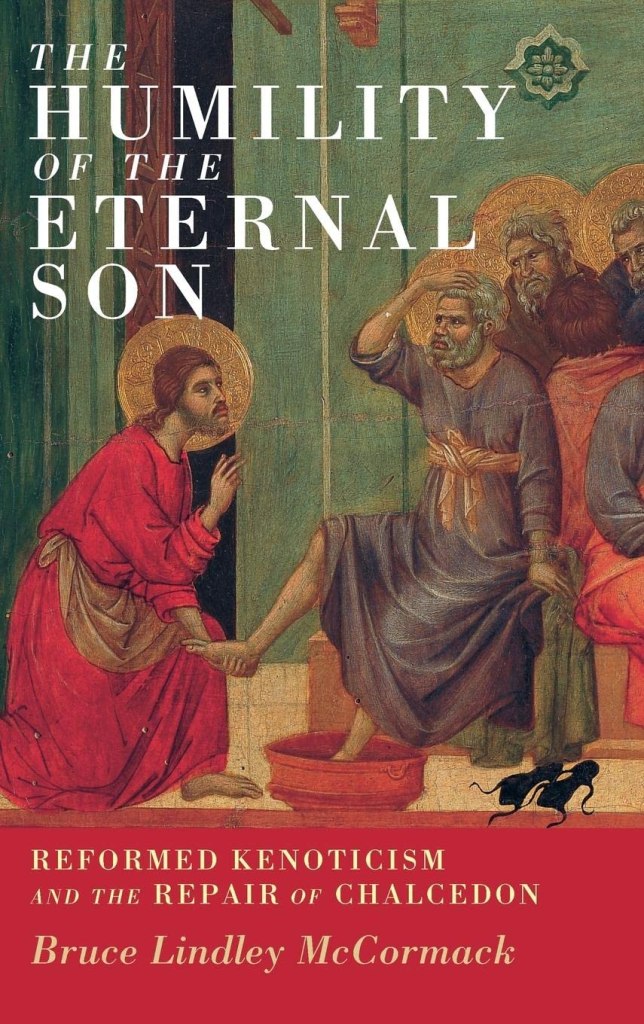
Bruce McCormack’s The Humility of the Eternal Son: Some Quotes and Thoughts

I am much too late to the game with Bruce McCormack’s study on Christology, The Humility of the Eternal Son. I am thankful to be done with it finally so that I can share a few quotes from the book and comment on the overall experience. The quotes I will be pulling from are from the very last chapter where he is summarizing his argument and responding to practical rebuttals to what he is proposing.

McCormack here, as hinted at in the subtitle, attempts a “repair” of the Chalcedonian Definition; as a faulty statement, he claims, about the full truth regarding Jesus Christ’s ontological makeup as both God and human, the Chalcedonian Definition has at its core a “logical aporia” (his term). By “logical aporia” he means a contradiction in the Definition which ultimately only pays lip service to the “side” of Jesus Christ that is fully human. McCormack explains this by writing that the Definition is funded by “Cyrilline” presuppositions concerning divine being. The fault in the Definition, grounded in these presuppositions, is that it claims the reality of Jesus is constituted by the Eternal Logos’s instrumentalization of human flesh. Although the orthodox theologians affirmed that – against Apollinaris – the Logos had taken on the entire reality that is human nature, in function they refused to concede that the Eternal Logos was affected by the union like the human nature was affected in being assumed by the Logos. The problem, ultimately, for McCormack, is how to situate the Christological subject. What constitutes, ontologically, the reality that is Jesus Christ? To McCormack, if the Logos is not affected by Jesus as Jesus is affected by the Logos, then the Definition’s claim that it safeguards the integrities of both natures is empty and groundless. This is so because “the attributes of both ‘natures’ must be ‘communicated’ to the Logos is he is to be the single Christological subject.”[1]

When I read the first chapter of this book, I felt both perplexed and excited. McCormack is telling his reader he aims to wade through the history of theological reflection, attempt a thorough investigation into a foundational doctrine of the Church, and then propose an essential reformulation of it. As someone interested in the history of theology, I was thrilled to slug through this book even though I had reservations about the prospects of its success. I get the sense that McCormack strays left of me, so to speak, in regards to his reverence for the Tradition. I will temper that claim, though, with an insightful remark of his:

“My point is this: we must be more ‘Chalcedonian’ than many of today’s defenders of Chalcedon are. We must not rest content with repeating words whose significance we have only dimly understood. We must do our Christology in the light of an appreciation for both the promise of Chalcedon and its limitations – and in that way, be truly ‘guided’ by it.”[2]

Amen and amen.

Perhaps the primary thought I came away with when reading this book – which is also how I have felt after putting down books by Torrance, Webster, et al. – is that this is an example of a theologian who has learned well from his master in the field, the inimitable Karl Barth. In McCormack’s (and Webster’s) case theirs wasn’t a direct, personal influence, but they nonetheless have been schooled in the fruitful halls of Barth’s post-metaphysical thought. Theological reflection, in the Barthian mode, is one I have always been convinced is creatively receptive. Theology is all the better for it.

What follows are a few quotes from his last chapter which do the work of appropriate theological speech:

“In the place of two discreet (substantially conceived) ‘natures’ subsisting in one and the same ‘person,’ I am going to posit the existence of a single composite hypostasis, constituted in time by means of what I will call the ‘ontological receptivity’ of the eternal Son to the ‘act of being’ proper to the human Jesus as human. ‘Ontological receptivity,’ it seems to me, is the most apt phrase for describing the precise nature of the relationship of the ‘Son’ to Jesus of Nazareth as witnessed to in the biblical texts we treated. I am going to argue further that it is the Son’s ‘ontological receptivity’ that makes an eternal act of ‘identification’ on the part of the Logos with the human Jesus to be constitutive of his identity as the second ‘person’ of the Trinity even before the actual uniting occurs. This is what I believe to have been missing in Jüngel and Jenson. The ‘Son’ has as ‘Son’ an eternal determination for incarnation and, therefore, for uniting through ‘receptivity.’ He is, in himself, ‘receptive.’”[3]

“Divine power, then, should never be understood in abstraction from what God actually does. It should be understood as the ability to accomplish all of that which God wills to do in the way God wills to do it – and nothing more. ‘Metaphysical compliments’ are excluded where the triune ‘being’ of God is understood to be constituted in purpose-driven trinitarian processions.”[4]

“The love that God is, is not love in general but a highly concrete and very specific kind of love. It is a self-giving, self-donating, self-emptying love. And it is the eschatological being of the Christian in Christ that they are called, even now, to imitate, to live from and towards, in their daily lives.”[5]

And finally:

“For what God is, God’s ‘essence’ is to be found in God’s livingness and nowhere else. Where God is concerned, we may not begin with the question of what God is or even with the question of who God is. We must begin with the question of the place of God’s livingness. Only there can we learn the answers to the questions of who and what God is.”[6]

Soli Deo Gloria


[1] Bruce McCormack, The Humility of the Eternal Son: Reformed Kenoticism and the Repair of Chalcedon (Cambridge, UK: Cambridge University Press, 2021), 52.

[2] Bruce McCormack, The Humility of the Eternal Son: Reformed Kenoticism and the Repair of Chalcedon (Cambridge, UK: Cambridge University Press, 2021), 29.

[3] Bruce McCormack, The Humility of the Eternal Son: Reformed Kenoticism and the Repair of Chalcedon (Cambridge, UK: Cambridge University Press, 2021), 252.

[4] Bruce McCormack, The Humility of the Eternal Son: Reformed Kenoticism and the Repair of Chalcedon (Cambridge, UK: Cambridge University Press, 2021), 267.

[5] Bruce McCormack, The Humility of the Eternal Son: Reformed Kenoticism and the Repair of Chalcedon (Cambridge, UK: Cambridge University Press, 2021), 276.

[6] Bruce McCormack, The Humility of the Eternal Son: Reformed Kenoticism and the Repair of Chalcedon (Cambridge, UK: Cambridge University Press, 2021), 296.

Uncategorized

Church Dogmatics 2/I, The Journey So Far (Pt. 2)

As I’ve written in one of my most recent blog posts, I recently began the long journey towards completing Barth’s Church Dogmatics. I finished reading the first volume, 1/I, a few months ago. Since then, I have tried to supplement my reading with various smaller theological, sociological, and creative works (like John Webster’s Holy Scripture book, the new How to Know A Person by convert David Brooks, and Lewis’s Narnia series), but felt the need to get back on the road I vowed to trek – even if it ends up being a dead one. Since I thought going immediately into 1/II a bore, I thought I would skip to 2/I: the one which supposedly houses Barth’s unique exposition on the Reformed doctrine of election. I have yet to reach that particular part in it yet.

Regardless, I am glad I came back to Barth. The more I think about his writing, the more I ask myself on a daily basis “What would Barth think about this?” Hence, the more I find my view of faith evolving, transforming, and improving, since, in the last analysis, Barth’s own primary question throughout his theological writings is “What would Christ think about this?”, or more accurately, “What gives God the most freedom to be the God He has revealed Himself to be, in Christ, in this?” Such a question is bound to reap good and positive spiritual results in the Christian’s life. Such has been the case with me.

That’s about it right now. No quotes in this one. On a personal note: the steady stream of Word, Sacrament, and Lenten practice taken up by me and my wife has been a satiating stream of spiritual goodness. Whenever I return to Barth – i.e., whenever I return to Barth’s writings on the goodness, glory, and exclusive revealing power of the God revealed in the Christ we have been hearing and partaking of – I am reminded, all over again, of the goodness of the Shepard who leads us.

Soli Deo Gloria

Uncategorized

Rudolf Bultmann: A Surprising Resonance

Rudolf Bultmann is one of contemporary evangelicalism’s boogeymen. There are a number of theologians and biblical scholars who exist scribbled on the evangelical ret-con list, some more deserving of their placement on that list than others. As a dialectical theologian and higher critical New Testament scholar who wholeheartedly accepted the interpretive claims of German historico-critical scholarship in the twentieth century, Bultmann is on the more deserving side of that evangelical judgment. Christian theologians (lay or otherwise) are right to be careful when approaching his writings. The same can be said for theologians like Paul Tillich, who has a blog post or two dedicated to him here. Yet, reading Bultmann’s Jesus and the Word has turned out to be a more edifying endeavor halfway through the work than I thought would be the case when I decided to pick it up. To be sure, every other page or so features a scribbled note in the margin which expresses my constant inner cringing at the bleakness of Bultmann’s conception of my Lord; equally prevalent, though, are notes of mine which praise Bultmann’s obvious exegetical prowess and overall spiritual perception of the claims of Jesus.

I suppose it was inevitable that I would be reading Bultmann some day considering my reverence for Barth and Heidegger, two men who had profound influences on Bultmann as a theologian/scholar. One aspect of Bultmann’s Jesus and the Word which is at the heart of my own appreciation of Bultmann is his emphatic charge that existence and faith, according to Jesus, is not a neutral matter. Immediately, even from the beginning of the preface, Bultmann makes it clear – in true Heideggerian fashion – that the reader is thrust into confrontation with the Traditioned Voice of Jesus, which requires of him the decision of faith or non-faith, the choice to – by one’s will – become the sinner or the saint. In the same preface, he distinguishes his own theological project from others, claiming that real historical work is not simply recovering the facts of a situation or reconstructing some psychological profile (the programme of the liberal theologians), but allowing a reasonable construction of those facts speak to our innermost selves today: that we might be changed through the crisis of confrontation with these historical realities. To Bultmann, we must allow ourselves to be encompassed fully by God’s Word and Will, and in so doing make the concrete choice to be the saint, to will what God wills.

Bultmann goes out of his way to contrast Jesus’s thoroughly Hebraic message with the surrounding Greek dualisms of His day which posit the world in such a way where neutrality is a real option, claiming:

“With the attitude that obedience is subjection to a formal authority to which the self can be subordinated without being essentially obedient, a neutral position is possible. Man is so to speak only accidentally or occasionally claimed by God, and it is possible to suppose that he might not be so claimed, that this demand of God probably sometimes ceases because it is not an essential element of the human self before God… Hence too there are situations in which it is possible for a man to do nothing – neutral situations. And just this Jesus expressly denies… There is therefore no neutral position; obedience is radically conceived and involves the man’s whole being.”[1]

Bultmann continues a few pages after describing the way in which Jesus’s preached message differed from the Hebraic tradition in which He functioned, and even further critiques any sort of “Hellenistic” understanding of Jesus. He writes,

The good is the will of God, not the self-realization of humanity, not man’s endowment. The divergence of Jesus from Judaism is in thinking out the idea of obedience radically to the end, not in setting it aside. His ethic also is strictly opposed to every humanistic ethic and value ethic; it is an ethic of obedience. He sees the meaning of human action not in the development toward an ideal of man which is founded on the human spirit; nor in the realization of an ideal human society through human action… the action as such is obedience or disobedience, thus Jesus has no system of values.”[2]

I quite like this quote; I think it cuts against the grain of so much “theological” literature being produced in leftist-leaning seminaries today, as well as in even those seminaries which see one of the primary tasks of the Christian Church as “diversifying its portfolio” if you will, i.e., as using the cross for social justice purposes (which is of course the latest craze).

I think the greatest strength of Jesus and the Word (so far) is Bultmann’s discourses/commentaries on Jesus’s conception of love as obedience, which is wrapped up in his larger theme of decision as obedience. Bultmann has much to say about the simplistic, modernist view of “love,” and decision more generally, as contrasted to how Jesus charges his listeners to love and charity. He writes,

“You cannot love God; very well, then, love men, for in them you love God. No; on the contrary the chief command is this; love God, bow your own will in obedience to God’s. And this first command defines the meaning of the second – the attitude which I take toward my neighbor is determined by the attitude which I take before God; as obedient to God, setting aside my selfish will, renouncing my own claims, I stand before my neighbor, prepared for sacrifice for my neighbor as for God. And conversely the second command determines the meaning of the first: in loving my neighbor I prove my obedience to God. There is no obedience to God in a vacuum so to speal, no obedience separate from the concrete situation in which I stand as a man among men, no obedience which is directed immediately toward God… the neighbor is not a sort of tool by means of which I practice the love of God, and love of neighbor cannot be practiced with a look aside toward God. Rather, as I can love my neighbor only when I surrender my will completely to God’s will, so I can love God only while I will what He wills, while I really love my neighbor.”[3]

Amen and amen, Bultmann. I couldn’t help but think of how Bultmann’s exposition of Jesus’s message of God-love and neighbor-love contrasts with the programme of a man like John Piper, whose explications of “Christian Hedonism” – i.e., “using your neighbor” for a baptized form of self-fulfillment – stands as such a different picture to this one. And this, written by a man who most definitely did not believe Jesus is God, nor God the Trinity!

The dialectical or crisis theologians have much to teach evangelicals today, even if we would shake our heads and yell “Nein!” at so much of the rest of their claims.

Soli Deo Gloria


[1] Rudolf Bultmann, Jesus and the Word (New York, NY: Scribner’s Library, 1958), 77-78.

[2] Rudolf Bultmann, Jesus and the Word (New York, NY: Scribner’s Library, 1958), 84.

[3] Rudolf Bultmann, Jesus and the Word (New York, NY: Scribner’s Library, 1958), 114-115.

Uncategorized

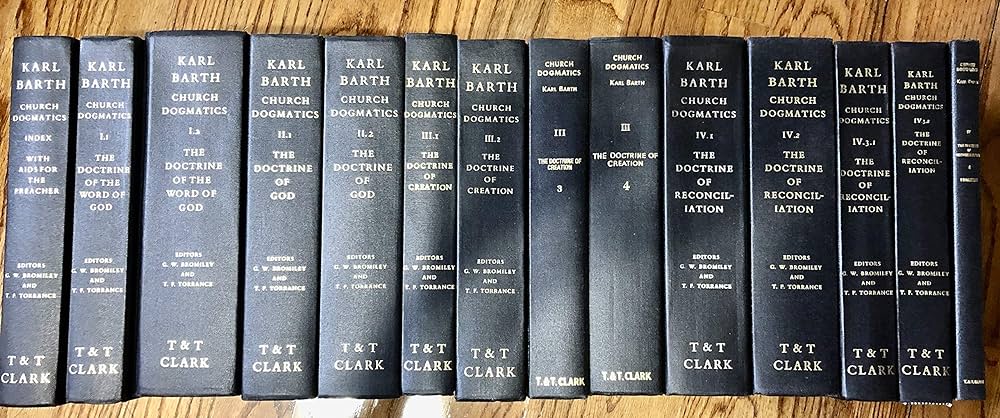
The Church Dogmatics, So Far

I just recently began reading the full-bodied, printed version of the Church Dogmatics (not a selection or reader, but the real thing). I decided to begin with 1/1 to get a better feel for Barth’s “prolegomena,” which is really a quite bad word for it – a word Barth himself spills a good bit of ink rejecting. In a way, however, it acts as the prolegomena in, at the very least, introducing the paths of language he will end up taking and the “objects” around which he will encircle throughout the rest of his programme. I heard it said once that Barth’s theology is like a diamond: each part contains the whole and the whole is a sum of all its parts. I am finding that to be true, because although his “object” is the Word of God – 1/1 is titled “The Doctrine of the Word of God” – he is equally concerned with Christology, Trinitarian theology, soteriology, and the theological task itself, each of which have a volume dedicated to it.

I have particularly been struck by Barth’s great mystery. As one more inclined to continental-sounding language – with its sometimes mind-bogglingly long and complex sentences – I am finding the literary style of Barth to itself be a Theo-logical extension or feature of his dogmatic affirmations (I cringe at the thought of using the word “system” here). He is quite the simultaneously joyful yet somberly-critical theologian, one concerned to give no beachheads to the anthropomorphizing thought of men. He himself makes it perfectly clear that, at the end of the day, his own theologizing is imperfect, flawed, limited as he is limited. This consistent emphasis of his gives the reader a helpful sense of the characteristic humanness of the theological task, one initiated and called forth by God but one which man must seek to fulfill because of that divine call (regardless of its ultimate futility as a human project of “listening” and “waiting” on the Word of God).

I don’t plan on slogging through the Dogmatics volume-by-volume, but skipping around his corpus based on my own theological interests at the moment. In step with this, next I plan on reading 2/1, arguably the most infamous of the volumes for its controversial reformulation of the Reformed doctrine of election. Although I am undoubtedly excited to get a more full-fledged hashing out of Barth’s election doctrine – I have read large portions of it included in the various Barth readers – I am honestly more interested in the Trinitarian theology I know is so intimately wrapped up in such a discussion on election, and the doctrine of God “generally” (Barth doesn’t like that word, either).

To end, some enriching quotes from my 1/1 reading so far:

“We have it [the Word of God] because it gives itself. Thus it is the object of proclamation in a different way from all possible objects of metaphysics or psychology… Real proclamation thus means God’s Word preached, and God’s Word preached means, in this second circle, man’s language about God on the basis of God’s self-objectification which is neither present nor predictable nor relatable to any design, but is real solely in the freedom of His grace, in virtue of which from time to time He wills to be the object of this language, and is so according to His own good pleasure.”[1]

“The man, the Church, the Church proclamation, the dogmatics which claimed to be able to work with the Word and with faith as with a capital sum standing at their disposal, would simply prove thereby that they possessed neither the Word nor faith. Where there is possession of them, we simply do not take it for granted as such, we strain after it hungering and thirsting, the only way of blessedness… This event, grace, and in and along with grace, faith, must come first. In confession, in connecting ourselves with the grace already proclaimed to us, already received by us, there results an affirmation of the possibility given to man of knowing the Word of God.”[2]

Soli Deo Gloria


[1] Karl Barth, Church Dogmatics 1/1: The Doctrine of the Word of God, G.T. Thomson trans. (Edinburgh, T & T Clark: 1963), 102-103.

[2] Karl Barth, Church Dogmatics 1/1: The Doctrine of the Word of God, G.T. Thomson trans. (Edinburgh, T & T Clark: 1963), 258.