Uncategorized

The Centrality of the Eucharist in the Christian Liturgy: A Reflection

My wife and I recently began our move over to the Anglican Communion from the low-church Baptist world.

This move was informed by numerous changes in conviction on a myriad of faith matters. The two primary channels through which I, personally, foresaw this move had to do with what I was reading in the Fathers and how I was viewing worship – particularly the elements of worship that made up my wife’s and my liturgical experience at the time. In other words, how I came to view the act of communal worship was out of step with how we were worshipping in our Baptist church. Rising above all the different layers of conviction-change taking place in us, the sacrament of the Eucharist had affected in us the most passionate response.

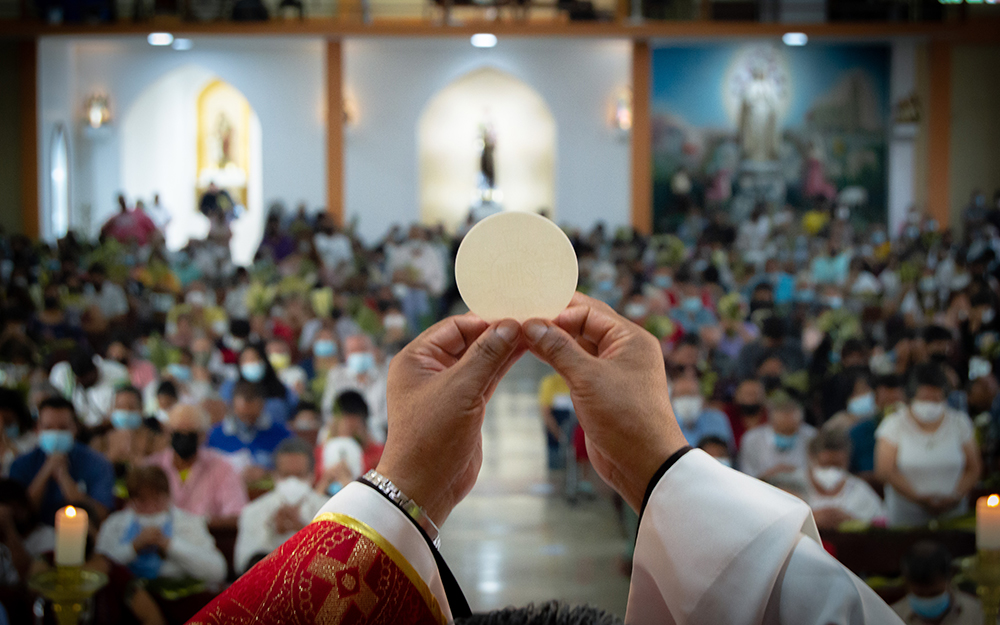
The Fathers are virtually unanimous in their assertion that what makes a liturgy a Christian liturgy is the inclusion of two elements: the Word and the Sacrament. Without either of these elements – otherwise explained as the preaching of the Bible and the administration of the Eucharist – a gathering of Christians together for communal worship is less than truly and fully Christian worship.

Why are both necessary? As a (former?) Baptist, I’m tempted to place a heavier importance on the Word than on the Sacrament; and in a way, this is right. Philosophically speaking, without the Word – the way in which the Sacrament’s intelligibility is disclosed – the Sacrament is not “brought home” to the congregation’s hearts and minds. Without the Word, the Sacrament is incomprehensible: the bread and the wine are not recognized for their unifying, soul-nourishing affects without a minister explaining that such is the case. Liturgically speaking, the Word is also very important: the homily or exposition on Scripture (determined either in step with the liturgical calendar or an expositional sermon series) is vital to hear what the Triune God has to say to His people.

All of these very true things are unbalanced, however, if the Sacrament is not celebrated. And here is why: the unity of the Church, as explicated by the Fathers, is not around the priest but around the Sacrament. Furthermore, the Eucharist is the location whereby God so acts upon His people so as to affect their spiritual nourishment through the Body and Blood of our Lord. The Eucharist is the foretaste of the “marriage supper of the lamb,” and hence the meal that brings the family of God together. Yet, it is also the food that comes down from heaven, the means of grace whereby God Himself spoonfeeds His children through His appointed priestly agents of grace. When the earliest Christian theologians spoke about the unity of the Church and the location of God’s constant acting-upon to nourish His loved ones, they spoke about the Eucharist (and the Bishop, but that’s another blog post).

Commenting on the theological milieu of the 20th century Catholic theologian Henri De Lubac, Sacramental theologian Hans Boersma remarks:

“He [De Lubac] maintains that when, by faith, we share in the one eucharistic body, the Spirit makes us one ecclesial body… the Eucharist makes the church… De Lubac [says]… You focus so much on what makes a legitimate Eucharist, and you zero in so unilaterally on the eucharistic body, that you forget that the sacramental purpose of the eucharistic body is to create the ecclesial body.”[1]

Then, on the next page, Boersma continues:

“The goal of the celebration of the sacrament was the unity or communion of the church…. For the medieval tradition, it was not an either/or option. Communion of holy things – meaning, communion with the body and blood of Christ – was related to the communion of saints. The one caused the other and was related to it in a sacramental manner.”[2]

So. The Word is indeed an integral piece of the Christian liturgy. In the Anglican tradition (along with the Catholic, Orthodox, Lutheran, Methodist, etc.), the practice of responsive Lesson-readings makes it so that the Word of God is rhythmically-placed throughout the service. Put these alongside the homily (also included in the above traditions) and the Christian liturgy is indeed Word-saturated. Without the Eucharist as the climax of the liturgy, though, the service becomes much more about what we (or, in this case, the pastor) do/does, rather than about how God is coming to meet us and unite Himself to us in these humble elements of bread and wine. The Eucharist is rightly central to the Christian liturgy in that it places the primary emphasis on how God is ministering/has ministered to us in Christ, rather than on how we ourselves are ascending to God through our liturgical (or expositional) prowess.

The Church is not only the people of God, but a hospital for sinners. Every hospital has consistent, particular medicines administered to the patients throughout the days, weeks, and months of their stay. The Sacraments are the medicine of the people of God during their stay in this sinfilled reality: the means whereby God imparts the grace of our Lord Jesus Christ to us, and in so doing affects their New Being in Him. In the words of Augustine (?), the Sacraments are the visible means of an invisible grace.

Take your medicine!

Soli Deo Gloria


[1] Hans Boersma, Heavenly Participation: The Weaving of a Sacramental Tapestry (Grand Rapids, MI: William B. Eerdmans Publishing Co., 2011), 114.

[2] Hans Boersma, Heavenly Participation: The Weaving of a Sacramental Tapestry (Grand Rapids, MI: William B. Eerdmans Publishing Co., 2011), 115.

Uncategorized

Paul Tillich, Faith, and Theological Reflection

The end of my last post includes a quotation from Paul Tillich’s Biblical Religion and the Search for Ultimate Reality which puts forth Tillich’s position on the compatibility between philosophy and theology. The central thesis of this little book is that philosophy and theology can, in fact, coexist, and are, even further, codependent on each other’s relevance and success as human thought projects. As a lay evangelical theologian, I went into reading his work with a cautious skepticism (which I was right to do), but nevertheless found some insights – about both philosophical investigation and theological speaking – which I thought would best be to throw out there and discuss.

A personal note: later this summer, I plan on flying up to Wisconsin to complete an audited class on the patristic doctrine of Participation at an Anglican seminary. My interest in the patristic vision, generally, stirred my interest in this, and so you can imagine that when I got to Tillich’s section on Participation (and our current age’s rejection of the participatory outlook) my interest piqued. He writes,

“In terms of the history of philosophy, it is a nominalistic ontology which has determined philosophical empiricism from the high Middle Ages to the present moment. Being, according to this vision of reality, is characterized by individualization and not by participation. All individual things, including men and their minds, stand alongside each other, looking at each other and at the whole of reality, trying to penetrate step by step from the periphery toward the center, but having no immediate approach to it, no direct participation in other individuals and in the universal power of being which makes for individualization… one thing must be emphasized. It is a view of reality as a whole.”[1]

Indeed, Tillich! While I have serious reservations about the attempts by many contemporary theologians (most of whom stem from high-church backgrounds) to revive the sort of participatory outlook so-long espoused by the Christian tradition, Tillich does a great job here of outlining the general philosophical air we breathe now: one which chokes us on our own scientistic individualism.

In the next chapter, Tillich displays his presuppositions concerning the nature of religion (Christianity including), but says some thought-provoking things that have real theological implications. He writes, concerning man’s tendency to anthropomorphize:

“There is no type of religion which does not personify the holy which is encountered by man in his religious experience… In the moment in which something took on this [sanctified] role, it also received a personal face. Even tools and stones and categories became personal in the religious encounter, the encounter with the holy. Persona, like the Greek prosopon, points to the individual and at the same time universally meaningful character of the actor on the stage. For person is more than individuality. ‘Person’ is individuality on the human level, with self-relatedness and world-relatedness and therefore with rationality, freedom, and responsibility. It is established in the encounter of an ego-self with another self, often called the ‘I-Thou’ relationship, and it exists only in community with other persons.”[2]

What struck me about this section of the reading is the utter truthfulness of his argument. As one who places himself (generally) within the Reformed theological camp, I place a high value on the proposition that humans, when left to their own devices, will 100% of the time fashion idols for themselves. Calvin’s whole “The heart is an idol factory” meets me with a hearty Amen. Humanity does not and cannot go on long without worshipping anything and everything as long as it is not the God revealed in Jesus Christ. We fashion ideological, material, and emotional gods for ourselves like hotcakes: it is our basic function as corrupted beings. Yet, the Eternal Son’s incarnation as Jesus Christ proclaims an insane and wonderful truth to us, that neither does God seek to be an impersonal God to us; in matter of fact, humanity cannot even come to know or understand a God who does not condescend to our human ways of knowing, thinking, speaking, and being. There is a double edged sword brought out by reflection on Paul Tillich’s assertions here: humanity both cannot understand a God who would require them to either transcend or escape their humanity (since there literally is no way for us to know or be known except in ways appropriate to our mode of being), yet humanity continually and doggedly insists on making created puppet-gods who conform to who we believe god should be (which ends, every time, in an anthropomorphized idol).

While there are numerous other sections of the book that I could comment on, I think his page-long discussion of the nature of faith presents some good, final theological-meat to chew on:

“Faith, in the biblical view, is an act of the whole personality. Will, knowledge, and emotion participate in it. It is an act of self-surrender, of obedience, of assent. Each of these elements must be present. Emotional surrender without assent and obedience would by-pass the personal center. It would be a compulsion and not a decision. Intellectual assent without emotional participation distorts religious existence into a nonpersonal, cognitive act. Obedience of the will without assent and emotion leads into a depersonalizing slavery. Faith unites and transcends the special functions of the human mind; it is the most personal act of the person… Biblical faith is the faith of a community, a nation, or a church. He who participates in this faith participates in its sumbolic and ritual expressions. The community unavoidably formulates its own foundations in statements which reveal its difference from other groups and protext it against distortions. He who joins the community of faith must accept the statements of faith, the creed of the community. He must assent before he can be received.”[3]

Perhaps this sort of definition of faith is at the heart of my insistence that the center of all theological language be Jesus Christ; it is why I am an avid reader of theologians like Karl Barth, Thomas F. Torrance, St. Athanasius, and the Cappadocian Fathers. Faith, says these figures, is real faith when it is a movement of the Christian’s being, when the intellectual assent which comes through prolonged theological reflection has a purpose and a mission. When simply joined to the ever-lethargic-and-hardly-ever-for-a-noble-purpose school of (in the end, anthropomorphizing) philosophy, theology becomes corrupted by the boundaries of the theologians’ study, the place which should be the locus of ministry and outreach. When evangelicals are lambasted by other sections of the Church on the grounds of some form of anti-intellectualism, I almost want to shout back “Because we have seen how y’all do it, hold’ up in your studies while the widows starve in your pews!” I will proudly wear the badge of anti-intellectual if it means my theologizing must always, always, always have practical ministry application, which is exactly what an absolute Christocentrism will accomplish for the ministry-minded theologian.

Ironically, Tillich realizes the problem that biblical (Christian) theologians have with philosophical speculation’s attempt to wed itself to the theological task. He writes,

“The Bible often criticizes philosophy, not because it uses reason, but because it uses unregenerated reason for the knowledge of God.”[4]


[1] Paul Tillich, Biblical Religion and the Search for Ultimate Reality (Chicago, IL: The University of Chicago Press, 1955), 17.

[2] Ibid., 22-23.

[3] Ibid., 53-54.

[4] Ibid., 56.