Close Reading

Robert Jenson’s Systematic Theology: The (New) Triune Relations

Robert Jenson is known for many things: his emphasis on the sacraments, his theological creativity, his reliance on Hegel, his reliance on Barth, his ability to speak theology concisely, and the list goes on. One aspect of his theology I have not seen touched on as much, however, are the new relations he posits the Church should consider as helpful descriptors for how to conceptualize the Triune Life. He affirms quite joyfully the traditional relations – generation, spiration, origination, procession – but proposes that not-before-seen reciprocal relations be recognized as constituting the Spirit’s dynamic contribution to God’s ontology.

ST: The Spirit as Liberator and Reconciler

Jenson introduces the new relation of liberation into the life of the Trinity. He does this so as to heed Hegel’s (and Buber’s) thoughts concerning what constitutes a healthy I-Thou relation. For Jenson and these thinkers, within the isolated person-to-person relationship there can only be a form of obsessive relational domination. If there are only two partners of relation, there can only be a subject-object and hence a master-slave dynamic as the only possible dynamic. This can be plainly seen in the obsession with which abusive partners find others – all others, friends of the beloved perhaps primarily – as threats to the lover’s enjoyment and satisfaction of the beloved. Inversely, the lover whose enjoyment of the beloved because of or alongside of the friends and companions surrounding the beloved is said to be a healthy, relationally-balanced individual. Jenson and Hegel would wholeheartedly agree. The only way the two partners can be freed for their love and enjoyment of one another, they argue, is if a third party opens up the two partners for their mutual love for one another. The Holy Spirit fulfills this function for the Father and the Son, and in so doing is rightly characterized, like Augustine said, as the love-bond of the Trinity.

Jenson writes: “If you and I are to be free for one another, each of us must be both subject and object in our converse. If I am present in our converse as myself, I am a subject who have you as my object. But if I am not also an object for you as subject, if I in some way or degree evade reciprocal availability to you as one whom you in your turn can locate and deal with, I enslave you, no matter with what otherwise good disposition I intend you.”[1]

In other words, if Father and Son are not reciprocally available for each-other as Father and as Son in the bond of their Spirit-love, there is no Triune God like the Tradition says. Without the Spirit, there is no true bond or relational openness as constitutive of God’s being, and therefore no true bond between the Son – who simply is the Lord Jesus Christ – and the Father He has been sent from. Jenson is convinced that previous theological missteps were taken in the history of doctrine because of a pre-existing blindness to this relational dynamic of the Spirit. To name a recent example, Jenson thinks that most of what should be criticized in his theological grandfather, Karl Barth, has to do with Barth’s malnourished (and possibly nonexistent) doctrine of the Holy Spirit. He goes so far as to say that, when it comes to the Church Dogmatics, Barth proposes what looks much more like a “binity” than a Trinity.

He further elaborates: “So we must learn to think: the Spirit is indeed the love between two personal lovers, the Father and the Son, but he can be this just in that he is antecedently himself. He is another who in his own intention liberates Father and Son to love each other. The Father begets the Son, but it is the Spirit who presents this Son to his Father as an object of the love that begot him, that is, to be actively loved. The Son adores the Father, but it is the Spirit who shows the Father to the Son not merely as ineffable Source but as the available and lovable Father.”[2]

It is in being the glue of the Father and Son that the Holy Spirit exists as the Tradition’s third hypostasis. “The Spirit is himself the one who intends love, who thus liberates and glorifies those on whom he ‘rests’; and therefore the immediate objects of his intention, the Father and the Son, love each other, with a love that is identical with the Spirit’s gift of himself to each of them.”[3] This sort of change to Augustine’s initial thesis does what Augustine arguably did not do, which was to recognize the personal element in the Holy Spirit’s procession from the Father and the Son. It is not simply as some thing called “the love between Father and Son” that the Spirit acts; such a conception is what led to the plumb line of the West’s depersonalization of the Spirit. It is as the one who, in proceeding from Father and Son, acts to blossom the generation and paternity of Father and Son for each other that the Spirit is a subsisting relation, i.e., as the subsisting relation of openness and freedom.

To conclude:

“The Father begets the Son and freely breathes his Spirit; the Spirit liberates the Father for the Son and the Son from and for the Father; the Son is begotten and liberated, and so reconciles the Father with the future his Spirit is. Neat geometry is lost, but life is not geometrical.”[4]

Soli Deo Gloria


[1] Robert Jenson, Systematic Theology, Vol. I: The Triune God (Oxford, UK: Oxford University Press, 1997), 155.

[2] Robert Jenson, Systematic Theology, Vol. I: The Triune God (Oxford, UK: Oxford University Press, 1997), 156.

[3] Robert Jenson, Systematic Theology, Vol. I: The Triune God (Oxford, UK: Oxford University Press, 1997), 158.

[4] Robert Jenson, Systematic Theology, Vol. I: The Triune God (Oxford, UK: Oxford University Press, 1997), 161.
Uncategorized

The Church Dogmatics, So Far

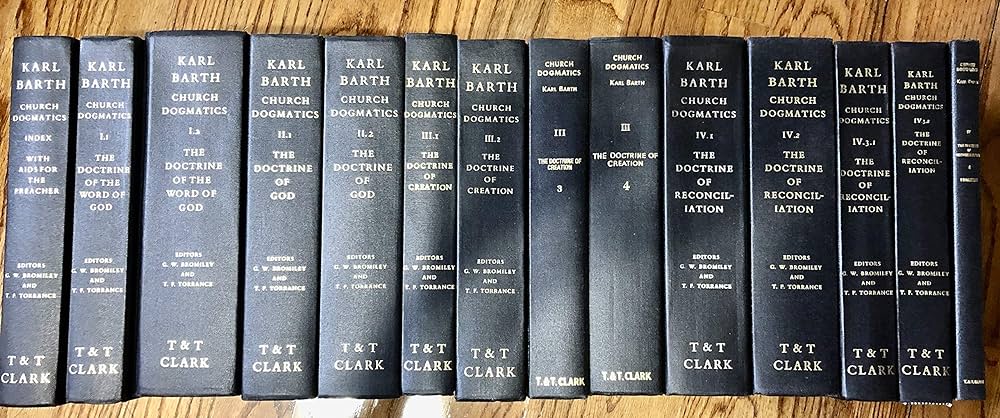
I just recently began reading the full-bodied, printed version of the Church Dogmatics (not a selection or reader, but the real thing). I decided to begin with 1/1 to get a better feel for Barth’s “prolegomena,” which is really a quite bad word for it – a word Barth himself spills a good bit of ink rejecting. In a way, however, it acts as the prolegomena in, at the very least, introducing the paths of language he will end up taking and the “objects” around which he will encircle throughout the rest of his programme. I heard it said once that Barth’s theology is like a diamond: each part contains the whole and the whole is a sum of all its parts. I am finding that to be true, because although his “object” is the Word of God – 1/1 is titled “The Doctrine of the Word of God” – he is equally concerned with Christology, Trinitarian theology, soteriology, and the theological task itself, each of which have a volume dedicated to it.

I have particularly been struck by Barth’s great mystery. As one more inclined to continental-sounding language – with its sometimes mind-bogglingly long and complex sentences – I am finding the literary style of Barth to itself be a Theo-logical extension or feature of his dogmatic affirmations (I cringe at the thought of using the word “system” here). He is quite the simultaneously joyful yet somberly-critical theologian, one concerned to give no beachheads to the anthropomorphizing thought of men. He himself makes it perfectly clear that, at the end of the day, his own theologizing is imperfect, flawed, limited as he is limited. This consistent emphasis of his gives the reader a helpful sense of the characteristic humanness of the theological task, one initiated and called forth by God but one which man must seek to fulfill because of that divine call (regardless of its ultimate futility as a human project of “listening” and “waiting” on the Word of God).

I don’t plan on slogging through the Dogmatics volume-by-volume, but skipping around his corpus based on my own theological interests at the moment. In step with this, next I plan on reading 2/1, arguably the most infamous of the volumes for its controversial reformulation of the Reformed doctrine of election. Although I am undoubtedly excited to get a more full-fledged hashing out of Barth’s election doctrine – I have read large portions of it included in the various Barth readers – I am honestly more interested in the Trinitarian theology I know is so intimately wrapped up in such a discussion on election, and the doctrine of God “generally” (Barth doesn’t like that word, either).

To end, some enriching quotes from my 1/1 reading so far:

“We have it [the Word of God] because it gives itself. Thus it is the object of proclamation in a different way from all possible objects of metaphysics or psychology… Real proclamation thus means God’s Word preached, and God’s Word preached means, in this second circle, man’s language about God on the basis of God’s self-objectification which is neither present nor predictable nor relatable to any design, but is real solely in the freedom of His grace, in virtue of which from time to time He wills to be the object of this language, and is so according to His own good pleasure.”[1]

“The man, the Church, the Church proclamation, the dogmatics which claimed to be able to work with the Word and with faith as with a capital sum standing at their disposal, would simply prove thereby that they possessed neither the Word nor faith. Where there is possession of them, we simply do not take it for granted as such, we strain after it hungering and thirsting, the only way of blessedness… This event, grace, and in and along with grace, faith, must come first. In confession, in connecting ourselves with the grace already proclaimed to us, already received by us, there results an affirmation of the possibility given to man of knowing the Word of God.”[2]

Soli Deo Gloria


[1] Karl Barth, Church Dogmatics 1/1: The Doctrine of the Word of God, G.T. Thomson trans. (Edinburgh, T & T Clark: 1963), 102-103.

[2] Karl Barth, Church Dogmatics 1/1: The Doctrine of the Word of God, G.T. Thomson trans. (Edinburgh, T & T Clark: 1963), 258.

Uncategorized

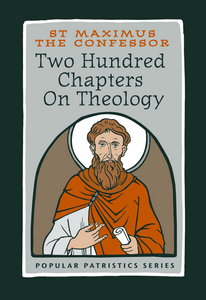
Maximus the Confessor on Deification in His Two Hundred Chapters on Theology

Maximus the Confessor is quickly becoming one of my favorite historical theologians. His characteristic Christocentrism, his healthy balance of apophatic and kataphatic theology, and his descriptions of the Christian life all lift up the soul to heights of love and peace which few contemporary Christian paperbacks have the ability to do. I am reminded of C.S. Lewis’s insistence, in his famous preface to Athanasius’s On the Incarnation, that, nine times out of ten it is the time-tested, ancient theological treatises which offer more spiritual encouragement than anything coming out in print today (with a few exceptions). I find the same to be true when reading Maximus; you can tell the man loved God, loved people, and found much growth in the contemplation of divine things. I myself benefit by allowing my soul to be lifted up by his theological movements.

When my wife and I were perusing the humungous Oxford book store, Blackwells, I came across a Patristics section which took up most of my time that day. While there, I purchased SVS Press’s copy of Maximus’s Two Hundred Chapters on Theology. It is turning out, in only the first few pages, to be enormously rich and spiritually and theologically precious to me. There is much gold to be dug up, here.

Maximus begins his work by setting up a few guard rails about God’s absolute otherness, using terms I have only ever read Dionysius use (i.e., “super-substantial” and “absolutely above/beyond essence or substance”). He then goes on to describe the inner life of the one whose spiritual/thought life is continually disciplined to draw itself up to God:

1.13 He who has dazzled the intellect with divine thoughts, and has accustomed his rationality unceasingly to celebrate the creator with divine hymns, and has hallowed his sensory perception with unadulterated mental representations – such a one has added to the natural beauty in accordance with the image, the deliberate good in accordance with the likeness.”[1]

You can see here the patristic conception of image/likeness in Maximus, as well as a definition of deification as a mystical union or sharing, an unutterable love-relationship which God and Man continually keep up with one another (based on both God’s and Man’s dual initiative). Reading 1.13 reminded me of a similar statement of Maximus’s in his Ambiguum, where his explanation of mystical union revolves around something like the idea of being fully encompassed by the Other. To Maximus, our union with Christ is a full-encompassing, where, though we keep our essential humanity intact, we are known and are seeking to be more known only in line with those characteristics and particularities as filtered through God’s gifting of them. In other words, we refuse to be known or encompassed apart from our own total-identification and encompassing by Christ. Glorious.

Three “chapters” later, Maximus illustrates a provocative picture of salvation which further attempts an elucidation of deification. He writes,

“And he who has been purified, is illuminated; and he who has been illuminated is made worthy to lie with the bridegroom Word in the chamber of the mysteries.”[2]

Maximus chooses to relate our union with God to the sexual union which a husband and wife share on their wedding night. He caveats that image, though, with the “mysteries” as the place wherein that sexual union takes place. Now, by “mysteries” he means the sacraments of the Church: the Eucharist and Baptism. So, the sacramental mysteries are the means through which God unites himself, continually, to his people. Without a consistent participation on the part of the Bride (the Church) in the mysteries (the Eucharist), the Bride and Groom (the Word, Christ) are not in full union and their relationship is not initiated or brought to completion. Again, glorious.

In case you thought Maximus the Pelagian, however, he insists, later on in the first forty or so chapters, that:

1.31 Never can a soul reach out towards the knowledge of God if God himself does not, having condescended, lay hold of it and lead it up to himself. For a human mind is not strong enough to ascend such a distance – as if to seize for its part some divine illumination, if God himself did not draw it upward, as far as is possible for a human mind to be drawn upward, and enlighten it with divine radiances.”[3]

Such union, mediated to the Bride in the mysteries, is more rightly said to be initiated and brought to its end by the Groom, i.e., Christ. It is Christ who reaches toward the Christian and pulls him up to union with Himself. Christ gets the credit and the glory for the Triune work he completes in us, using the mysteries, to do such work.

Amen, amen, and amen!

For those who want a deep spiritual nourishment beyond the steady flow of contemporary, popular Christian literature (much of which misses the point), turn to the ancient fathers for the golden honey of biblical wisdom. Turn to the Tradition, and be satiated.


[1] St. Maximus the Confessor, Two Hundred Chapters on Theology (Yonkers, NY: SVS Press, 2015), 51.

[2] St. Maximus the Confessor, Two Hundred Chapters on Theology (Yonkers, NY: SVS Press, 2015), 53.

[3] St. Maximus the Confessor, Two Hundred Chapters on Theology (Yonkers, NY: SVS Press, 2015), 61.