–
–
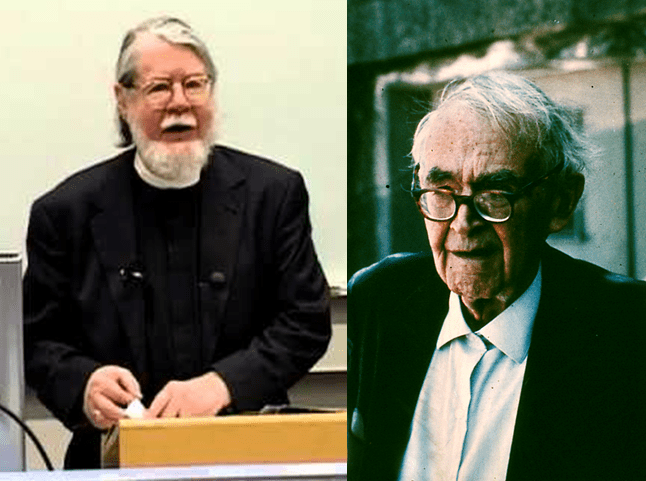
Robert Jenson’s Systematic Theology Vol. I is a treasure trove of beautiful doctrinal insights. Near the end of his first section, he comments on what is needed to engage with the theological tradition in an honest way. Just like Webster argues in his magisterial Holy Scripture, Jenson posits that the only way a coherent doctrine of Scripture can be formulated and maintained is one grounded in the self-presentation of the God who is Trinity; i.e., the one who Jesus reveals in the Spirit by calling Him Father.
Here are two block quotes from Jenson sure to bless your soul and mind.
First, on Scripture:
“Whenever someone has tried to construe the unity of Scripture otherwise than by the identity of this God the book has fragmented, first into Hebrew Scripture and New Testament and thereupon into traditions and genres and redactions within each. And when communities other than the church – in modernity, the communities of various ideologies and particularly the surreptitious such community of supposedly autonomous scholars – try to appropriate the Bible for their own purposes, the book falls into mere shards – to which, of course, anyone is welcome… The modern attempt to interpret scripture ‘historically’ has been intrinsically self-defeating and has now defeated itself, since it has curiously supposed that to interpret the Bible historically we must abstract from the history for whose attestation the church assembled this collection in the first place, the Incarnation and Resurrection of Christ.”[1]
The free-floating scholars out there, who claim to represent the rational person’s engagement with the biblical material, fall into meaninglessness. This is rooted in the Modernist’s blindness to his own placement in a history and a community; it would be better, I suspect Jenson would say, if the independent scholar would fly the banner of Atheistic Fragmentation as the community from which he wrestles with the material instead of the banner of View from Nowhere. Then, the presuppositional commitments the interpreter truly does hold would come to conscious explication, and wouldn’t be hidden beneath the false belief in one’s own prescient objectivity over and above the text.
Then, protology. Here is where Jenson sets forth his (self-avowed) revisionist theological agenda, one in the vein of Barth’s methodology but one that also decisively breaks with Barth at important points. He writes:
“God is not only identified by Exodus and Resurrection; he is identified with them. Thus we may state the point of this chapter yet one more time: the God to be interpreted in this work is the triune God. For the doctrine of the Trinity is but a conceptually developed and sustained insistence that God himself is identified by and with the particular plotted sequence of events that make the narrative of Israel and her Christ. The primal systematic function of trinitarian teaching is to identify the theos in ‘theology’… For if a systematically developed discourse about God precedes the exposition of Trinity, there is danger that a nontrinitarian identification of God may be hidden in that discouse, to confuse all that follows. Western theology’s late-medieval and modern tradition has tended to treat first of God simply as he is God and only thereafter of his Trinity; the temptations posed by this ordering have recently been much discussed. The extent to which any particular theologian may actually have fallen to these temptations is doubtless often arguable. The present work seeks to avoid the temptation altogether, by breaking with this aspect of the tradition.”[2]
This point is one famously highlighted by Barth about the way in which to approach the theological task. Jenson and Barth argue that, instead of tripping up himself at the beginning of the race by forcibly inserting the God of ancient Hellenism into his doctrinal engagement with the Word of God, the theologian should instead consciously set out to exegete the Scriptures in a Christian way (i.e., in a Trinitarian way). The God of “general” Theism has no place here.
I am not finished with Jenson’s ST just yet. As I plow through it, however, I am struck by the way in which Jenson’s philosophical commitments alter his approach, sometimes in very strange color schemes. Nonetheless, his dependence on Barth shines through in some of the best possible ways… not least in his emphasis on the centrality of God as Trinity.
Soli Deo Gloria
[1] Robert Jenson, Systematic Theology, Vol. I: The Triune God (New York, NY: Oxford University Press, 1997), 59.
[2] Robert Jenson, Systematic Theology, Vol. I: The Triune God (New York, NY: Oxford University Press, 1997), 60.

 Alex Renner's Blog