–
My wife and I recently began our move over to the Anglican Communion from the low-church Baptist world.
This move was informed by numerous changes in conviction on a myriad of faith matters. The two primary channels through which I, personally, foresaw this move had to do with what I was reading in the Fathers and how I was viewing worship – particularly the elements of worship that made up my wife’s and my liturgical experience at the time. In other words, how I came to view the act of communal worship was out of step with how we were worshipping in our Baptist church. Rising above all the different layers of conviction-change taking place in us, the sacrament of the Eucharist had affected in us the most passionate response.
The Fathers are virtually unanimous in their assertion that what makes a liturgy a Christian liturgy is the inclusion of two elements: the Word and the Sacrament. Without either of these elements – otherwise explained as the preaching of the Bible and the administration of the Eucharist – a gathering of Christians together for communal worship is less than truly and fully Christian worship.
Why are both necessary? As a (former?) Baptist, I’m tempted to place a heavier importance on the Word than on the Sacrament; and in a way, this is right. Philosophically speaking, without the Word – the way in which the Sacrament’s intelligibility is disclosed – the Sacrament is not “brought home” to the congregation’s hearts and minds. Without the Word, the Sacrament is incomprehensible: the bread and the wine are not recognized for their unifying, soul-nourishing affects without a minister explaining that such is the case. Liturgically speaking, the Word is also very important: the homily or exposition on Scripture (determined either in step with the liturgical calendar or an expositional sermon series) is vital to hear what the Triune God has to say to His people.
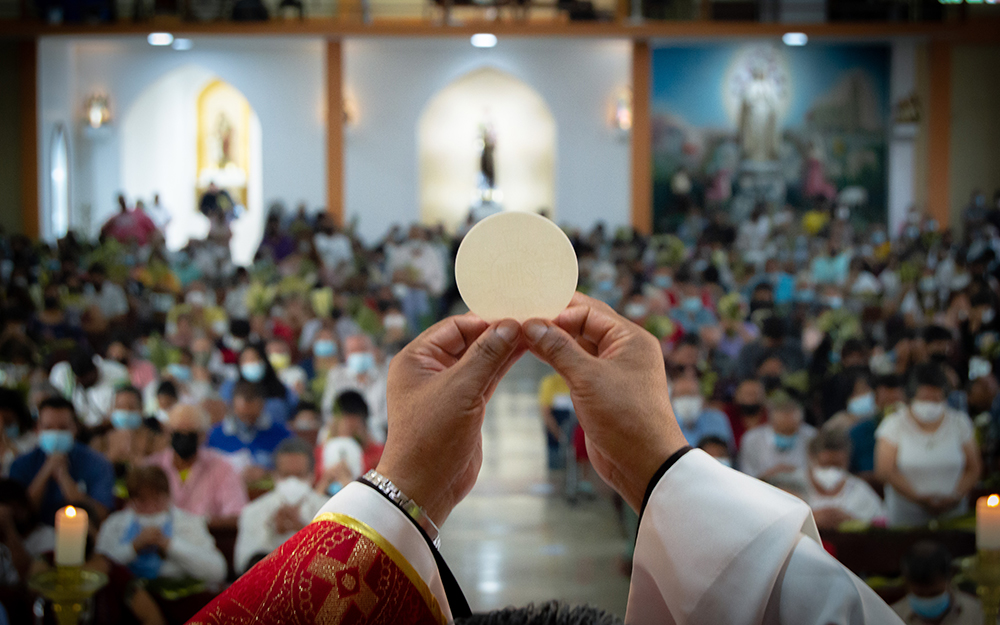
All of these very true things are unbalanced, however, if the Sacrament is not celebrated. And here is why: the unity of the Church, as explicated by the Fathers, is not around the priest but around the Sacrament. Furthermore, the Eucharist is the location whereby God so acts upon His people so as to affect their spiritual nourishment through the Body and Blood of our Lord. The Eucharist is the foretaste of the “marriage supper of the lamb,” and hence the meal that brings the family of God together. Yet, it is also the food that comes down from heaven, the means of grace whereby God Himself spoonfeeds His children through His appointed priestly agents of grace. When the earliest Christian theologians spoke about the unity of the Church and the location of God’s constant acting-upon to nourish His loved ones, they spoke about the Eucharist (and the Bishop, but that’s another blog post).
Commenting on the theological milieu of the 20th century Catholic theologian Henri De Lubac, Sacramental theologian Hans Boersma remarks:
“He [De Lubac] maintains that when, by faith, we share in the one eucharistic body, the Spirit makes us one ecclesial body… the Eucharist makes the church… De Lubac [says]… You focus so much on what makes a legitimate Eucharist, and you zero in so unilaterally on the eucharistic body, that you forget that the sacramental purpose of the eucharistic body is to create the ecclesial body.”[1]
Then, on the next page, Boersma continues:
“The goal of the celebration of the sacrament was the unity or communion of the church…. For the medieval tradition, it was not an either/or option. Communion of holy things – meaning, communion with the body and blood of Christ – was related to the communion of saints. The one caused the other and was related to it in a sacramental manner.”[2]
So. The Word is indeed an integral piece of the Christian liturgy. In the Anglican tradition (along with the Catholic, Orthodox, Lutheran, Methodist, etc.), the practice of responsive Lesson-readings makes it so that the Word of God is rhythmically-placed throughout the service. Put these alongside the homily (also included in the above traditions) and the Christian liturgy is indeed Word-saturated. Without the Eucharist as the climax of the liturgy, though, the service becomes much more about what we (or, in this case, the pastor) do/does, rather than about how God is coming to meet us and unite Himself to us in these humble elements of bread and wine. The Eucharist is rightly central to the Christian liturgy in that it places the primary emphasis on how God is ministering/has ministered to us in Christ, rather than on how we ourselves are ascending to God through our liturgical (or expositional) prowess.
The Church is not only the people of God, but a hospital for sinners. Every hospital has consistent, particular medicines administered to the patients throughout the days, weeks, and months of their stay. The Sacraments are the medicine of the people of God during their stay in this sinfilled reality: the means whereby God imparts the grace of our Lord Jesus Christ to us, and in so doing affects their New Being in Him. In the words of Augustine (?), the Sacraments are the visible means of an invisible grace.
Take your medicine!
Soli Deo Gloria
[1] Hans Boersma, Heavenly Participation: The Weaving of a Sacramental Tapestry (Grand Rapids, MI: William B. Eerdmans Publishing Co., 2011), 114.
[2] Hans Boersma, Heavenly Participation: The Weaving of a Sacramental Tapestry (Grand Rapids, MI: William B. Eerdmans Publishing Co., 2011), 115.

 Alex Renner's Blog