–
–
The two philosophers who most captured my imagination during my sophomore and junior years of college were Martin Heidegger and Ludwig Wittgenstein. Heidegger held a sort of demonic allure for me, if I’m honest, captivating me to go nose-to-nose with death unending and bid me keep staring. Wittgenstein, on the other hand, held a certain mystical aura around him that smelt of thick wisdom, his philosophizing yielding constant insights, myself sighing sighs of relief following hard-earned wrestling with his texts. Reading Wittgenstein was a rather different experience than reading Heidegger, whose works gave the reader the sense that they were being further pushed into the nothingness of Dasein.
Wittgenstein produced the most out-going living in me, too, if it can be put like that. His philosophy helped me see the sobriety that comes with submitting to my own intellectual and physical limitations, and in so doing freed me for them. His later philosophy invited me to a level-headed engagement with the language games and forms of life which define reality for me, and helped me see them from the proper perspective; i.e., from within them.
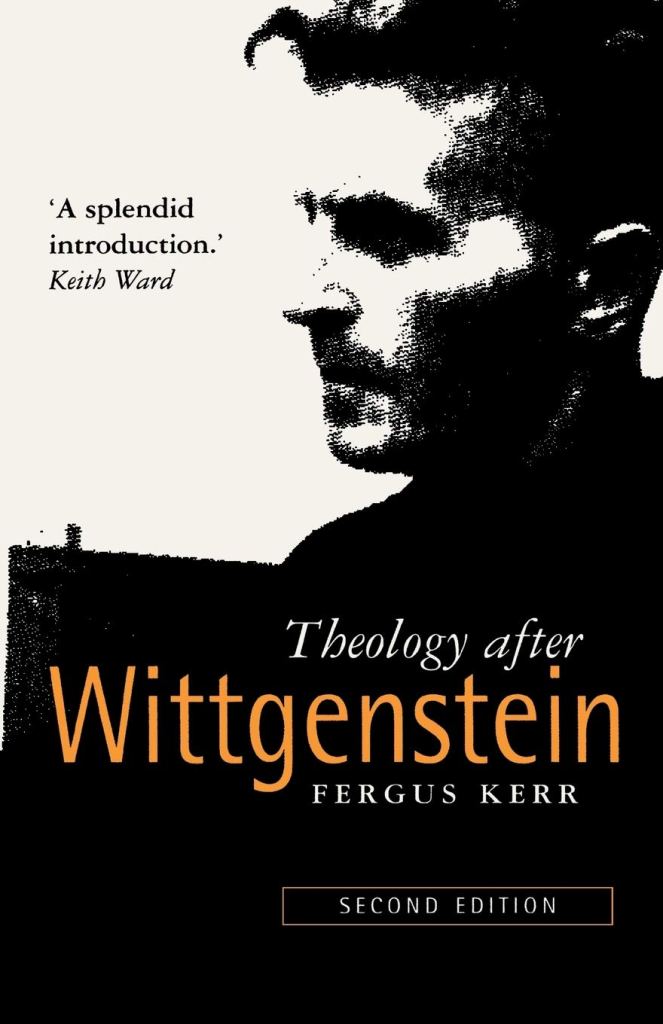
Fergus Kerr has written the definitive work on Wittgenstein’s relationship to the theological task in Theology after Wittgenstein.
I have a distinct memory of walking through a decrepit old used bookstore during a trip I took in college and finding an old book, published in the 70s, geared towards a theological analysis of Wittgenstein’s philosophy. After finishing it, however (it was a rather small book), I couldn’t shake the feeling that its treatment just didn’t do justice to the breadth of Wittgenstein’s significance for theology. That little book was called Ludwig Wittgenstein: The Bearing of His Philosophy Upon Religious Belief. Upon finishing Kerr’s book, I found corroboration for the feeling I had upon putting that old book down.
The Myth of the Wordless (and World-less) Self
Before starting Theology After Wittgenstein, I imagined I would be reading a good deal about Wittgenstein’s influence, and not so much a treatment of his philosophy proper. This expectation was quickly undermined. Theology After Wittgenstein is primarily concerned to introduce the theological student to Wittgenstein’s corpus and major contributions, only secondarily applying such insights of his to the Christian framework. Of course, this feature does not therefore lessen the theological applicability of its insights, but was simply something I did not expect.
The first section attempts a bob and weave maneuver through Wittgenstein’s deconstruction of the “metaphysical myth” of Descartes’s philosophy of mind. In particular, Kerr focuses on how Wittgenstein can be used to help cure the Tradition’s tendency to posit a non-linguistic, un-mediated experience of God. In both ancient and modern forms, Kerr says, the Church has tended to hold out this experience as not only possible but preferable as the form of communion with God containing the most reality. The ancient understanding of bodily existence tended to see human bodies as an obstacle to a true and living faith, as something that must be purged and transcended. How some ancient theologians described the beautific vision hinted at a sort of ontological change that supposedly turns the blessed into beings not quite still human. In the modern world, the experience of the divine comes when the universal religious impulse, which is a decidedly psychological muscle, is tapped into; it is only through this stirring of the religious affections – a language-less activity – that God can be really reached. Here, too, one must transcend one’s boundedness in history so as to get in touch with “the really real,” i.e., the experience of religious ecstasy. What both epochs held can be summed up in the proposition: Who you really are is located somewhere behind or within your physical, world-bound existence.
The irony of the modern understanding of the self is that it looks strikingly similar to how the ancients characterized God (at least when describing his numerous “attributes”). Kerr writes, “The self who is free to survey the world from no point of view within the world often turns out to be the self who is totally impenetrable to anyone else – in this being once again rather like the hidden God of classical theism.”[1] Funny enough, and in line with contemporary theologians’ characterization of the Enlightenment’s effect on man’s self-understanding, Kerr claims that the modern man is just the Christian God without benevolence or love.
Continuing to diagnose, Kerr then says, “In the modern case, it is the natural universe that is to be represented as independently as possible of all human interpretation. In the ancient case, the self wants to lose itself in dispassionate contemplation of the reality that subsists in itself. In both cases, however, the subject is required to transcend human emotions, cultural and historical particularity, and the like, in order to encounter bare, that which is truly important.”[2] This is remarkably insightful.
The Limits of Our Language
In league with this conversation is the related discussion about the centrality of language. Part of Wittgenstein’s allure, especially when it comes to his later writings, is his teaching on the public nature of the Lebensformen, the forms of life, and the linguistic-constitution of humanity’s being-in-the-world (if I may use that term). Kerr writes, “Language is the conversation that is interwoven with the characteristic activities of human life.”[3]
In short: Wittgenstein’s contribution is to point out that it is a falsehood to think of language as the means whereby we pick things out in the world. Language is not the tool that exists between ourselves to communicate what we would otherwise communicate in some immediate way. Rather, language is what allows us to experience things at all. Language is the waters in which we swim; it is our constitution. To quote him directly, “Whereof one cannot speak, thereof one must be silent”; meaning, know your place, human. You are not a god; you are bound by language.
Kerr says, “Wittgenstein’s wry… remarks are intended to provoke us into reflecting on the limits of our knowledge, and why we find these limits so chafing and restrictive. Why do we have to, or want to, devalue human ways of knowing in comparison with the unmediated knowledge that a god must presumably have? In questioning the validity of this (often hidden) object of comparison, Wittgenstein invites us to remember ourselves as we really are. Once and for all, that is to say, we need to give up comparing ourselves with ethereal beings that enjoy unmediated communion with one another.”[4] And this is not a bad thing to hear, especially for theologians.
Kerr continues on this point, this time in a theological key, that “a metaphysically generated concept of the human body, derived from the thought of the immateriality and invisibility of the soul, displaces our experience of the whole living man or woman. This picture of the body gets in the way of our conversation with one another… Behavior as such is supposed to lack significance, in such a way that when it does appear significant it has to be because it is the outwardly observable effect of certain internal mental goings-on. The mind retreats from the face, just as the immaterial soul once disappeared behind the body.”[5] In other words, Kerr writes, the idea of the Metaphysical self has kept us alienated from the acceptance of the face-value truth of our own physical, historical, and linguistic limitations. We have been stuck in a metaphysical prison of our own making, one which has disallowed the materiality of our beings to come to the fore. It is in our refusal to accept this that we have become mistaken about who we are, and what are our capabilities.
“What if despising signs for their inert and inorganic materiality is to collude, however unwittingly, in centuries of discrimination against the mundane realities of how human beings live in community with one another?”[6] Absolute. Fire.
Fergus Kerr a Catholic Theologian?
Perhaps my one confusion about the book is really with the author. Fergus Kerr is one of the most prominent Dominican (meaning, Roman Catholic) theologians of the last fifty years. Perhaps this will betray a misunderstanding on my part, but does not the Catholic tradition stand as the arbiter and defender of the very conceptions Kerr uses Wittgenstein to dismantle? I may require a deeper reading of the Catholic Catechism to make this claim with more grounding, but it seems to me that the dualistic metaphysical world Wittgenstein seeks to tear down is precisely the one held up by many Catholic theologians (at least the ones who are committed to the Neoplatonism of some of its ancient thinkers). On the other hand, of course, Catholicism does a much better job of emphasizing the role of the body’s truth in relation to the whole of Christian life than Protestantism does, but Descartes was not a Lutheran. Just a thought.
I highly recommend you purchase and ponder Theology After Wittgenstein.
Soli Deo Gloria
[1] Fergus Kerr, Theology After Wittgenstein (Oxford, UK: Blackwell Publishing, 1986), 18.
[2] Fergus Kerr, Theology After Wittgenstein (Oxford, UK: Blackwell Publishing, 1986), 25-26.
[3] Fergus Kerr, Theology After Wittgenstein (Oxford, UK: Blackwell Publishing, 1986), 30.
[4] Fergus Kerr, Theology After Wittgenstein (Oxford, UK: Blackwell Publishing, 1986), 45.
[5] Fergus Kerr, Theology After Wittgenstein (Oxford, UK: Blackwell Publishing, 1986), 46.
[6] Fergus Kerr, Theology After Wittgenstein (Oxford, UK: Blackwell Publishing, 1986), 48.
 Alex Renner's Blog