Uncategorized

Paul Tillich, Faith, and Theological Reflection

The end of my last post includes a quotation from Paul Tillich’s Biblical Religion and the Search for Ultimate Reality which puts forth Tillich’s position on the compatibility between philosophy and theology. The central thesis of this little book is that philosophy and theology can, in fact, coexist, and are, even further, codependent on each other’s relevance and success as human thought projects. As a lay evangelical theologian, I went into reading his work with a cautious skepticism (which I was right to do), but nevertheless found some insights – about both philosophical investigation and theological speaking – which I thought would best be to throw out there and discuss.

A personal note: later this summer, I plan on flying up to Wisconsin to complete an audited class on the patristic doctrine of Participation at an Anglican seminary. My interest in the patristic vision, generally, stirred my interest in this, and so you can imagine that when I got to Tillich’s section on Participation (and our current age’s rejection of the participatory outlook) my interest piqued. He writes,

“In terms of the history of philosophy, it is a nominalistic ontology which has determined philosophical empiricism from the high Middle Ages to the present moment. Being, according to this vision of reality, is characterized by individualization and not by participation. All individual things, including men and their minds, stand alongside each other, looking at each other and at the whole of reality, trying to penetrate step by step from the periphery toward the center, but having no immediate approach to it, no direct participation in other individuals and in the universal power of being which makes for individualization… one thing must be emphasized. It is a view of reality as a whole.”[1]

Indeed, Tillich! While I have serious reservations about the attempts by many contemporary theologians (most of whom stem from high-church backgrounds) to revive the sort of participatory outlook so-long espoused by the Christian tradition, Tillich does a great job here of outlining the general philosophical air we breathe now: one which chokes us on our own scientistic individualism.

In the next chapter, Tillich displays his presuppositions concerning the nature of religion (Christianity including), but says some thought-provoking things that have real theological implications. He writes, concerning man’s tendency to anthropomorphize:

“There is no type of religion which does not personify the holy which is encountered by man in his religious experience… In the moment in which something took on this [sanctified] role, it also received a personal face. Even tools and stones and categories became personal in the religious encounter, the encounter with the holy. Persona, like the Greek prosopon, points to the individual and at the same time universally meaningful character of the actor on the stage. For person is more than individuality. ‘Person’ is individuality on the human level, with self-relatedness and world-relatedness and therefore with rationality, freedom, and responsibility. It is established in the encounter of an ego-self with another self, often called the ‘I-Thou’ relationship, and it exists only in community with other persons.”[2]

What struck me about this section of the reading is the utter truthfulness of his argument. As one who places himself (generally) within the Reformed theological camp, I place a high value on the proposition that humans, when left to their own devices, will 100% of the time fashion idols for themselves. Calvin’s whole “The heart is an idol factory” meets me with a hearty Amen. Humanity does not and cannot go on long without worshipping anything and everything as long as it is not the God revealed in Jesus Christ. We fashion ideological, material, and emotional gods for ourselves like hotcakes: it is our basic function as corrupted beings. Yet, the Eternal Son’s incarnation as Jesus Christ proclaims an insane and wonderful truth to us, that neither does God seek to be an impersonal God to us; in matter of fact, humanity cannot even come to know or understand a God who does not condescend to our human ways of knowing, thinking, speaking, and being. There is a double edged sword brought out by reflection on Paul Tillich’s assertions here: humanity both cannot understand a God who would require them to either transcend or escape their humanity (since there literally is no way for us to know or be known except in ways appropriate to our mode of being), yet humanity continually and doggedly insists on making created puppet-gods who conform to who we believe god should be (which ends, every time, in an anthropomorphized idol).

While there are numerous other sections of the book that I could comment on, I think his page-long discussion of the nature of faith presents some good, final theological-meat to chew on:

“Faith, in the biblical view, is an act of the whole personality. Will, knowledge, and emotion participate in it. It is an act of self-surrender, of obedience, of assent. Each of these elements must be present. Emotional surrender without assent and obedience would by-pass the personal center. It would be a compulsion and not a decision. Intellectual assent without emotional participation distorts religious existence into a nonpersonal, cognitive act. Obedience of the will without assent and emotion leads into a depersonalizing slavery. Faith unites and transcends the special functions of the human mind; it is the most personal act of the person… Biblical faith is the faith of a community, a nation, or a church. He who participates in this faith participates in its sumbolic and ritual expressions. The community unavoidably formulates its own foundations in statements which reveal its difference from other groups and protext it against distortions. He who joins the community of faith must accept the statements of faith, the creed of the community. He must assent before he can be received.”[3]

Perhaps this sort of definition of faith is at the heart of my insistence that the center of all theological language be Jesus Christ; it is why I am an avid reader of theologians like Karl Barth, Thomas F. Torrance, St. Athanasius, and the Cappadocian Fathers. Faith, says these figures, is real faith when it is a movement of the Christian’s being, when the intellectual assent which comes through prolonged theological reflection has a purpose and a mission. When simply joined to the ever-lethargic-and-hardly-ever-for-a-noble-purpose school of (in the end, anthropomorphizing) philosophy, theology becomes corrupted by the boundaries of the theologians’ study, the place which should be the locus of ministry and outreach. When evangelicals are lambasted by other sections of the Church on the grounds of some form of anti-intellectualism, I almost want to shout back “Because we have seen how y’all do it, hold’ up in your studies while the widows starve in your pews!” I will proudly wear the badge of anti-intellectual if it means my theologizing must always, always, always have practical ministry application, which is exactly what an absolute Christocentrism will accomplish for the ministry-minded theologian.

Ironically, Tillich realizes the problem that biblical (Christian) theologians have with philosophical speculation’s attempt to wed itself to the theological task. He writes,

“The Bible often criticizes philosophy, not because it uses reason, but because it uses unregenerated reason for the knowledge of God.”[4]


[1] Paul Tillich, Biblical Religion and the Search for Ultimate Reality (Chicago, IL: The University of Chicago Press, 1955), 17.

[2] Ibid., 22-23.

[3] Ibid., 53-54.

[4] Ibid., 56. 
Uncategorized

Baptists, Barth, and Holding to Your Tradition

Karl Barth, if you couldn’t tell, has played a monumental role in the recent refining of my theological speech concerning God and man. Yet, Barth has also helped me think through a special difficulty I perceive many young, low-church Christian men are also wrestling with: a pull towards the high churches (Anglicanism, Eastern Orthodoxy, etc.). In my own experience, this (primarily liturgical) pull originated after I dove headfirst into the theological writings of many of the patristic figureheads like Athanasius of Alexandria, Cyril of Alexandria, the Cappadocian Fathers, etc. Learning about the patristic theological vision (centered around things like theosis, a robust Trinitarian theology, a deep sacramentology, etc.) pushed me to rethink the tradition in which I have functioned as a Christian, since what I was hearing from the pulpit was not (wholly) what I was reading in the Fathers.

This crisis event led me to seriously consider (and almost act on) a decision to split with the Baptists. However, as time went on, and my theological readings continued and widened (all while sweating over a decision to leave), I further clarified my stances on certain issues concerning the sacraments, the Trinity, and Christian spirituality generally; surprising to myself, I didn’t come out as someone who would be completely out of place among the Baptist fold. Instead of giving in to the pressure of many higher church apologists today – who ruthlessly pursue young men of other Christian folds in order to usher them into their own “true” church – I decided to meditate further on the implications of discontinuity of belief and practice across Christian history. I also found other Baptists who were wrestling with the doctrinal dizziness of the historic Church, Baptists who were trying to appropriate richer, less-dismissive practices within the wider Baptist culture, and (yes!) Baptists who held a similar love and sympathy for theologians like Barth and Torrance.

Back to Barth. As a theologian constantly exposed to traditions different from his own (as an out-of-place, theologically Reformed instructor in primarily Lutheran universities throughout Germany), Barth was forced to deal with the central claims and distinctives of his own tradition of which he had been previously ignorant. Today, many young men who begin to wrestle with the claims of their own tradition, while simultaneously meditating on the doctrine of the Church past, see jumping overboard to another ship as the only valid option (because of numerous factors like the general rootlessness which young people feel, a quick-and-ready choosiness available to anyone and everyone, and a decidedly individualistic American spirit). For Barth, however, who was daily brought up against the looming Lutheran giants around him, the option of switching traditions was an inconceivable option. Barth, for all the allurements which the traditions surrounding him presented, remained decidedly Reformed. Over time, though, he began to tweak his own tradition’s understandings of its distinctives as he garnered more and more due influence across theological circles, and was criticized for it. Now, I don’t mean to compare myself with Barth as some theological pioneer or hero, but I take comfort in his story which has certain similarities with my own. Barth took the hard way: he stuck with those who had nurtured him in the faith and sought to influence the Reformed church according to problems he perceived needed fixing.

Contemporary (American) Baptists have many theological, ministerial, and liturgical problems. They are by no means guiltless when it comes to their annoying confusion over the significance of central doctrines of the faith (the Hypostatic Union, the Trinity) and their subsequent appropriation of those doctrines for the sole end of holding up their prized elucidation of penal substitution. They have an almost offensive disregard for and ignorant misunderstanding of traditional liturgical forms (although this is changing), and a biblicism that gets much of their language in trouble, especially when its mixed with isolated rural settings in which no one holds them accountable for their theological speaking. Baptists also have a tendency to idolize their leaders, and pastor-worship is by no means a small problem.

On the other hand, Baptists are virtually undisputed in regards to their evangelistic fervor, their love for the poor and the downcast, and their rigid and unflinching passion for the truthfulness of the Bible. As far as ministerial problems go, I would rather have an overdose of these issues than a mediocrity in any one of them. Perhaps the greatest lesson which Barth has imparted to me – other than doctrinal language I have found to be indispensable to a robust and informed theology – is embodied in his acceptance and appropriation of his own tradition. I’ll end with a quotation from the CD which Baptists, for all of their blemishes, firmly hold to heart:

“For who really knows what grace is until he has seen it at work here: as the grace which is for man when, because man is wholly and utterly a sinner before God, it can only be against him, and when in fact, even while it is for him, it is also a plaintiff and judge against him, showing him to be incapable of satisfying either God or himself? And looking back once again, it is the grace of God as mercy pure and simple, as a sheer Yes and Nevertheless, which reveals, and by which we have to measure, how it stands with the man to whom it is granted. It is not independent reflection on the part of man, or an abstract law, but grace which shows incontrovertibly that man has forfeited his salvation and in so doing fatally jeopardized his creaturely being – which reveals his sin and the misery which is its consequence. From the redemption which takes place here we can father from what it is that man is redeemed; from the pure fact of the salvation which comes to man without and in spite of his own deserts we may know the brute fact which he for his part dares to set against God. Because the ‘God with us’ at the heart of the Christian message has to do with that pure fact of the divine mercy, we must not fail to recognize but acknowledge without reserve that we, and those for whom God is according to this message, are those who have nothing to bring Him but a confession of this brute fact: ‘Father, I have sinned.’”[1]


[1] Karl Barth, Church Dogmatics IV/1 (Edinburgh: T&T Clark, 1956), 6-16.

Uncategorized

Barth on Theology

From Church Dogmatics II/2: here Barth gives a few preliminary remarks before expounding his unique (and revolutionary) take on the Reformed doctrine of Election.

“Theology must begin with Jesus Christ, and not with general principles, however better, or, at any rate, more relevant and illuminating, they may appear to be: as though He were a continuation of the knowledge and Word of God, and not its root and origin, not indeed the very Word of God itself. Theology must also end with Him, and not with supposedly self-evident general conclusions from what is particularly enclosed and disclosed in Him: as though the fruits could be shaken from this tree; as though in the things of God there were anything general which we could know and designate in addition to and even independently of this particular. The obscurities and ambiguities of our way were illuminated in the measure that we held fast to that name and in the measure that we let Him be the first and the last, according to the testimony of Holy Scripture. Against all the imaginations and errors in which we seem to be so hopelessly entangled when we try to speak of God, God will indeed maintain Himself if we will only allow the name of Jesus Christ to be maintained in our thinking as the beginning and the end of all our thoughts…”[1]

If Christological and Trinitarian Theology do not function as the central paradigms through which all other Christian doctrines are seen and interpreted, Barth says, the Christian theological project is doomed from the start. Since, for Barth, Jesus Christ is the unique and perfect and fully-revealing event of God’s-revealing-of-Self, to speak and presuppose (as the rest of the Western theological tradition does) that there can be true, substantial, or good things said about God apart from what is revealed in Jesus Christ – like what is propounded in so called “natural revelation” – is to take the wheels off the theological vehicle at the very beginning of the race. While Barth definitely aligns himself more with the Eastern Christian spirit of theologizing in this regard, his relegation of God’s-revealing exclusively to the Logos of God (Jesus Christ) even further separates him from the wider Christian tradition. Nevertheless, Barth is correct (albeit with a few caveats as to the locus of where Christ is to be found and subsequently interpreted).

The way Barth distinguishes himself from most all other theological methodologies is by refusing to subject his theological reflection to the “general principles” of philosophy and the analytic tradition’s conceptual structures, generally. Theologians would do well to see that the general direction of theological reflection today – a decidedly “post-metaphysical” direction – is not (surprise!) the spawn of Satan, but in fact should be seen as the heart of the task of the first-millennium-Church’s enterprise. Post-metaphysical theology, though it is admittedly being interpreted and applied in harmful and unbiblical ways, presents a better and more promising direction for the theologians who would uphold the absolute validity and infallibility of the Scriptures (all of which speak of Jesus Christ). Karl Barth points us towards where theology should be heading all the time: Christ, Christ, Christ! Any conceptual or philosophical shackles that would keep Christ caged should be done away with, destroyed, and left to the ashes of history.


[1] Karl Barth, Church Dogmatics II/2 (Edinburgh: T&T Clark, 1957), 4-11.

Uncategorized

Why Read Karl Barth?

*This is the most recent post from my former Wix blog, but I thought it would be a fitting first post for this blog considering what its purpose is. Enjoy!*

For Christmas this past year, I asked for two books: Incarnation by T.F. Torrance and Christiane Tietz’s new biography every theology nerd has been raving about, Karl Barth: A Life in Conflict. I can confidently say, even before I received the books, that the subjects of these two books have had more impact on my life and Christian walk than any other figure outside of the early church fathers. Further, my appreciation and passion for the writings of Torrance intimately stems from my appreciation for his spiritual and intellectual mentor, Karl Barth. Why should you read this towering, momentous figure Karl Barth? What is there to be gained by reading and meditating on Barth’s doctrinal and biblical expositions?

“There is no God behind the back of Jesus Christ.”

I first learned about Karl Barth after coming out of a Christian Theology class I took during my sophomore year in college. My theology professor kept saying this phrase in connection to natural theology (the assumption and study of the natural world in order to come to truths about who God is) and as time went on I was more and more captured by the phrase. My professor explained that many times theologians will speak as if what can be learned about God through nature is essential to truly understanding what Christians have in the biblical text. In other words, Christian theologians sometimes speak as if we needed the natural world in order to interpret the Bible. The more I kept thinking about that phrase, though, that “there is no God behind the back of Jesus Christ,” the more I came to see clearly the problems I was already perceiving in a theological system which allowed language about God to be bound by what we can see (or think we are seeing) in the natural world. My professor helped me realize that to concede that the natural world is a valid lens through which to interpret Divine Being is to refuse to take the revelation of God – which we most definitely have in Jesus Christ – as fully and authentically serious. Put simply: to look elsewhere other than where God has clearly said “Here I am!” is to not take God’s “Here I am!” seriously.

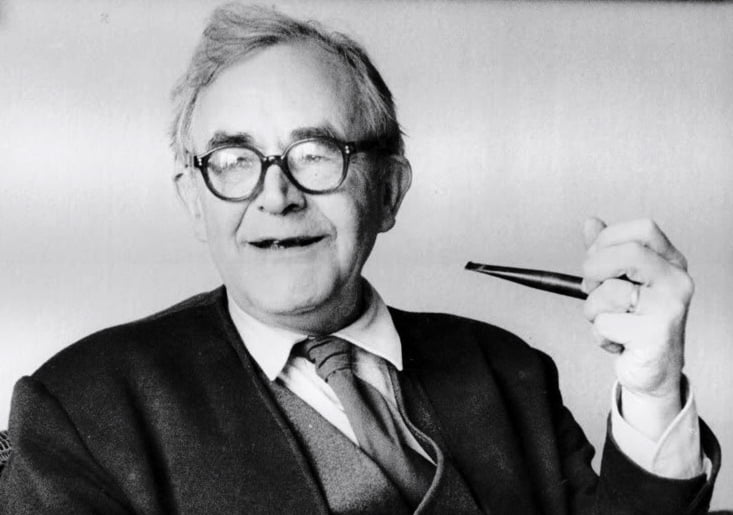
Where is God’s true and exclusive “Here I am!”? It is in Jesus Christ! Barth says. Barth’s famous quip demonstrates the absolute focus of the whole of his massive theological corpus: Christ, Christ, and only Christ! Now, my theology professor at the time would not have admitted that what he was espousing was what Barth taught – since evangelicals, generally, are not very friendly to Barth as they have considered his teachings on the Bible and the preaching moment – but, not being able to get the phrase out of my head I looked it up. And there, looking back, was Barth’s wrinkly, intelligent face. I immediately started devouring his more introductory works (like this one and this one), and was, simply, hooked!

Karl Barth is undoubtedly the most influential, provocative, and important theologian of the twentieth century. As the son of a well-respected academic himself, Barth grew up at the very beginning of the twentieth century, and through his political and theological disputations during the Second World War helped to cement his name and doctrine as internationally renown. Theologically, he is perhaps best known for his massive, unfinished set of theology books, the Church Dogmatics. Among the wider evangelical world, Barth is characterized by certain teachings of his which evangelicals perceive deviate from the norm of Christian orthodoxy (yet, considering the Protestant liberalism in which he grew as a theologian and thinker, he is a stark and healthy contrast). Perhaps one disclaimer could be made about Barth (this, keep in mind, coming from an evangelical myself): the way Barth is interpreted and appropriated today among those who are reasonably characterized as Progressive Christians may help you to see where Barth could have been clearer on the implications of what he wrote. This is not to say that how he is appropriated among Progressive Christianity today is the right way of interpreting Barth, but keep in mind that Barth has been used to espouse and set the cornerstone for contemporary Christian Progressivism (as seen in most of the mainline denominations). Nevertheless, he will undoubtedly go down as a flawed theologian who still helped the Church worldwide use language which benefitted Christians’ understanding of their own doctrines, like revelation, who God is in Christ, and, most of all, the nature of the Triune God’s relationship with humanity.

So, to return to the question: Why should you read Karl Barth?

Well, in my experience, to learn from Barth that the locus (the exclusive place) of God’s revelation is Jesus Christ (and, I would add, Jesus Christ as put forth by the whole biblical text) was to revolutionize my understanding of what the task of theology, and the Christian life, in turn, is all about. Some interesting implications, too, opened up concerning theology’s relationship with philosophy, and my understanding of what it means for “all truth to be God’s truth,” a favorite saying of many natural or analytic theologians. Karl Barth, as an expositor of God’s Word and as a Christian theologian in harmony with the voice of the Christian past, will help you to see the centrality, beauty, and exclusivity of the Lord Jesus Christ and the Triune God which he reveals to all people. Amid all of Barth’s heady and complicated theological musings is a beautiful, central focus on God as revealed in Christ, and can be a helpful, useful way of understanding anew the task that Christians have in continually reforming, re-using, and rethinking their employment of theological language.

Some works on Barth’s writings/life:

Newest Barth Anthology: https://www.amazon.com/Essential-Karl-Barth-Reader-Commentary/dp/1540960730.

Older Barth Anthology (written by one of his students): https://www.amazon.com/Barths-Church-Dogmatics-Helmut-Gollwitzer/dp/0567290514/ref=sr_1_2?crid=1ZPAMQKH40VOT&keywords=helmut+gollwitzer+barth&qid=1686231204&s=books&sprefix=helmut+gollwitzer+barth%2Cstripbooks%2C156&sr=1-2.

Classic Barth biography: https://www.amazon.com/Karl-Barth-Letters-Autobiographical-English/dp/0800604857/ref=sr_1_1?crid=1DN8514SX3KJO&keywords=eberhard+busch&qid=1686231272&s=books&sprefix=eberhard+busch%2Cstripbooks%2C154&sr=1-1#customerReviews.

Newest Barth biography (expands more on his relationship with student/partner Charlotte Von Kirschbaum): https://www.amazon.com/Barth-Professor-Systematic-Theology-Christiane/dp/0198852460/ref=sr_1_1?crid=2YLANCC2PPXFM&keywords=karl+barth+a+life+in+conflict&qid=1686231320&s=books&sprefix=karl+barth+a+life+in+conflic%2Cstripbooks%2C159&sr=1-1.

Barth’s massive Church Dogmatics (only for the truly O.G. Barth fans): https://www.abebooks.com/servlet/BookDetailsPL?bi=31521117842&ref_=ps_ggl_17730966692&cm_mmc=ggl-_-US_Shopp_Trade50up-_-product_id=COM9781598564426USED-_-keyword=&gclid=CjwKCAjw-IWkBhBTEiwA2exyOy5tvNBEYDxO7YWiHNjyGbuudJfveDY51VhbwcGSIhS8KVV-ObP9JRoCN-0QAvD_BwE.