“One Substance, Three Persons.”
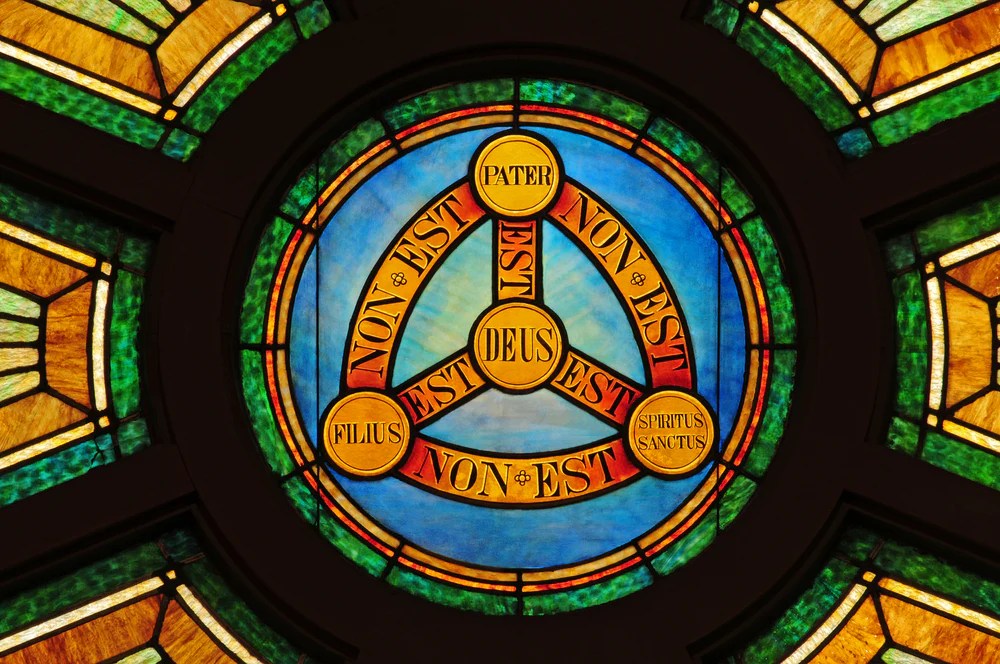
Such is the mantra used virtually across the board in many Western churches when tasked with describing the ontological makeup of God. Purportedly, the Christian God is Trinity: He is one God made up of Father, Son, and Spirit. How this is the case is usually chalked up to “mystery” and “unknowability” (two helpful terms to be sure but usually used as cop outs from further theological reflection). Queue the diagram which supposedly helps with the comprehension of such a mysterious reality:
–
–
Pictured are three circles, each titled with the name of one of the Divine Persons, positioned around a fourth circle entitled “God.” Touching each circle are lines labeled “Is Not” connected at both ends between each person, and between each person and the “God” circle in the middle are lines labeled “Is.”
This diagram is not helpful, and here’s why.
Late theologian John Zizioulas, in his landmark book on Patristic theology and Personhood called Being as Communion, writes:
“The idea took shape in Western theology that that which constitutes the unity of God is the one divine substance, the one divinity; this is, as it were, the ontological ‘principle’ of God. But this interpretation represents a misinterpretation of the Patristic theology of the Trinity. Among the Greek Fathers the unity of God, the one God, and the ontological ‘principle’ or ’cause’ of the being and life of God does not consist in the one substance of God but in the hypostasis, that is, the person of the Father. The one God is not the one substance but the Father, who is the ’cause’ both of the generation of the Son and of the procession of the Spirit. Consequently, the ontological ‘principle’ of God is traced back, once again, to the person.”[1]
What Zizioulas does here, remarkably, is point out that in the theology of the Cappadocian Fathers – the most significant theologians of the Trinity other than Athanasius – the Person acts as the center of God’s substance, and not the idea of “substance” or “Being” as applied to God. In other words, instead of Being holding priority in Trinitarian language – as it did in the Western Church, over time – it should in fact be the Person-in-relation that holds priority, particularly the Person of the Father (who is the Ground, the Unoriginate Originator of the Son and Spirit). There is no fourth circle labeled “God” in God; there is no fourth thing in God in which the three participate. Such a conception – which is exactly what the diagram above is relating – makes Greek ontology, rather than the God revealed in Jesus Christ, prior in Trinitarian thinking. Remarkably, what this correction reaps for Christian theology is that it means Being in God is relational.
God cannot be conceived, the Fathers tell us, except as Being-in-relation, and, hence, Being-in-relation is who the God revealed in Jesus Christ is. There is no such “supreme being” in existence other than the one that Jesus Christ reveals, a claim contrary to the mountain of literature on Western monotheism’s supposed overlapping belief systems. There is no unmoved Mover who can comfortably be ascribed as the God and Father of our Lord Jesus Christ. That God is the God of the philosophers, but not the Christian God. The Christian God finds His Being in the Person of the Father, who in eternity begets His Son and spirates His Holy Spirit. The Being of the Son and the Spirit, therefore, live as derived-Being, as Being-from, not as Originator-of like the Father. Yet, the Father, too, is Being-in-relation; there was never a time when the Father was not with His Son and His Spirit. The Father, though underived in His Being, is still Being-in-relation and not exclusively Being-in-Himself. All of this lends itself to what Torrance calls a “dynamic” conception of God’s ontology (which is really the biblical conception) rather than a “static” formula as attributed to the West’s thinking following Augustine.
Zizioulas continues, a few pages later:
“The manner in which God exercises His ontological freedom, that precisely which makes Him ontologically free, is the way in which He transcends and abolishes the ontological necessity of the substance by being God as Father, that is, as He who ‘begets’ the Son and ‘brings forth’ the Spirit… For this communion is a product of freedom as a result not of the substance of God but of a person, the Father–observe why this doctrinal detail is so important–who is Trinity not because the divine nature is ecstatic but because the Father as a person freely wills this communion.”[2]
Exactly, sir! Here here! In other words, we must look to the Father as the “fountainhead” – a title the Fathers gave Him – of divinity, the one Paul calls “God” (θεοs) explicitly in all of His Trinitarian introductions. The sense this makes of Paul’s statements cannot be clearer:
“Grace to you and peace from God our Father and the Lord Jesus Christ” (1 Cor. 1:3)
“Grace and peace to you from God our Father and the Lord Jesus Christ” (Gal. 1:3)
“Grace and peace to you from God our Father and from the Lord Jesus Christ” (Rom. 1:7b)
Like Zizioulas argues, Paul always gives the Father the title “God,” not because (as the Arians believe) He is the only truly Divine Person but because Divinity rightly originates in Him. Jesus Christ is labelled “Lord” and the Holy Spirit “Holy” because of their rightful placement on the God-side of the God-world divide, but within that God-side there exist definite two-way relations which constitute God as Trinity: namely Origination (from the Father to the Son and the Spirit, received by the Son and Spirit), Generation (from the Father to the Son, received by the Son), and Procession (from the Father… to the Spirit, received by the Spirit).
The last significant thing Zizioulas writes in relation to this discussion he writes on page 46:
“The expression ‘God is love’ (1 John 4:16) signifies that God ‘subsists’ as Trinity, that is, as person and not as substance. Love is not an emanation or ‘property’ of the substance of God–this detail is significant in the light of what I have said so far–but is constitutive of His substance, i.e., it is that which makes God what He is, the one God. Thus love ceases to be a qualifying–i.e., secondary–property of being and becomes the supreme ontological predicate. Love as God’s mode of existence ‘hypostatizes’ God, constitutes His being.”[3]
Boom. Zizioulas here articulates what I have found so hard to find the language for: that John’s statement about God as love is not some fluffy though true affirmation of God’s character, but Love is Who He is. Seen in the light of this discussion on God’s relations, John’s statement makes all the more sense. In other words, “God is love” means “God is Trinity.” Therefore, the core nugget of truth at the heart of the Apostolic Christian Tradition – and hence the Gospel – is that God is relational in his very Being of Being, Zizioulas argues, and in Jesus Christ and by the Holy Spirit we are brought into that very relational heart of God, bid by the Father to become united to the Lord Jesus Christ by faith affected in us by His Spirit. May our theologizing, our communal experience as “eucharistic communities” (his term), and our very lives be shaped by the relational heart of the God revealed in Jesus Christ, who is Trinity.
Soli Deo Gloria
[1] John D. Zizioulas, Being as Communion: Studies in Personhood and the Church (Crestwood, NY: St. Vladimir’s Seminary Press, 1985), 40-41.
[2] John D. Zizioulas, Being as Communion: Studies in Personhood and the Church (Crestwood, NY: St. Vladimir’s Seminary Press, 1985), 44.
[3] John D. Zizioulas, Being as Communion: Studies in Personhood and the Church (Crestwood, NY: St. Vladimir’s Seminary Press, 1985), 46.