–
–
The Encyclical
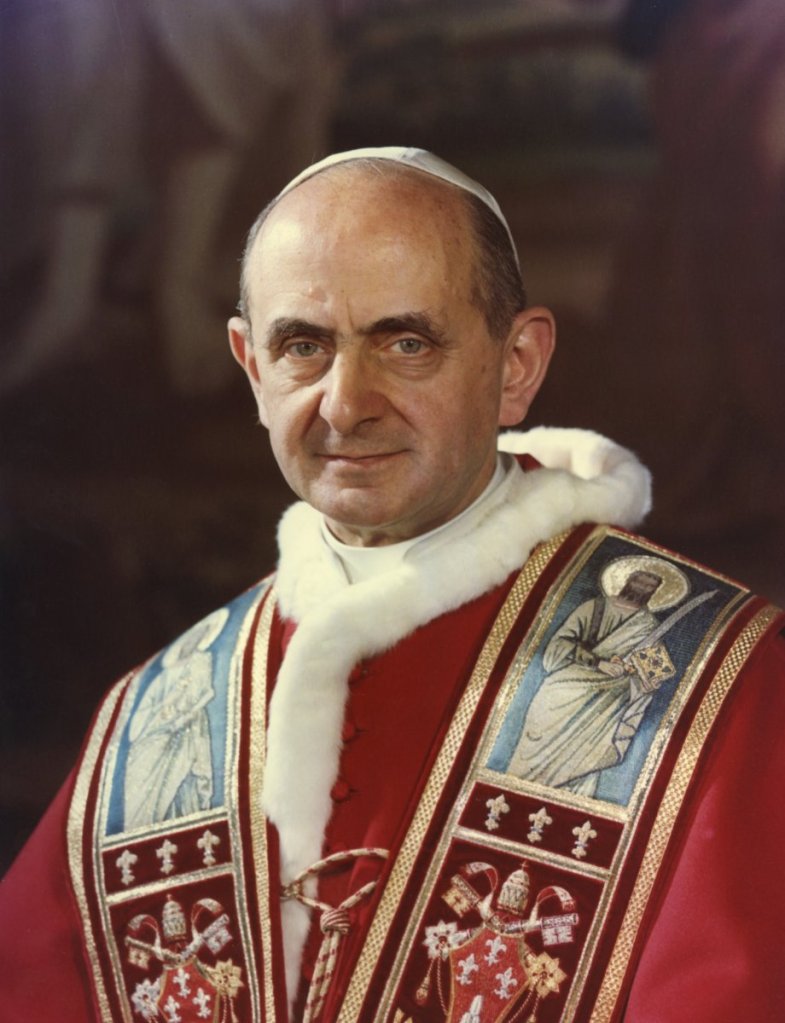
Humanae Vitae is the name of the papal encyclical written by Pope Paul VI in 1968 which addresses issues of the family and birth control. It was written before large amounts of the world decided to make artificial birth control a legalized medical reality, and the heart behind the letter was to call the nations of the world to moral account, to resist the “technical expedients” being made available to people. Technology was expanding its reach into most all areas of human life, and nations were heeding its call with an eery obedience. The technological attitude was spreading its worldwide campaign and the Pope sought to stand against it (or, at the very least, to temper its lust). In many ways Humanae Vitae is an artifact of the titanic theological war that has been waging for centuries between what popular theologians call the “disenchanted world” and the “enchanted world.” Or, antiquity and modernity. Platonism and materialism.
Masterfully, Paul VI calls into question technology’s function within the life of man. Behind all of his theologizing there lurks these palpable questions: What world-concept informs the urge to relegate all of man’s natural faculties to non-human entities? Further, what frame of mind must man hold in order to conclude that he is master of life itself, the belief implicated in the use of artificial birth control? Most importantly, what philosophical worldview is at work in the push to disallow the natural function of reproduction to “follow through” in producing children?
Paul VI’s letter reiterates the Roman Catholic Church’s teaching that artificial birth control runs contrary to the natural shape of Man as designed by God. He writes, “To experience the gift of married love while respecting the laws of conception is to acknowledge that one is not the master of the sources of life but rather the minister of the design established by the Creator.”[1] Further, by its very nature artificial birth control seeks to hijack and suppress the natural workings of the person, holistically conceived. Paul VI writes, “We must accept that there are certain limits, beyond which it is wrong to go, to the power of man over his own body and its natural functions – limits, let it be said, which no one, whether as a private individual or as a public authority, can lawfully exceed. These limits are expressly imposed because of the reverence due to the whole human organism.”[2] Crucially and theologically, for Christians, ABC contradicts the principle by which and through which those who have been baptized into Christ – the Selfless One – are to function: according to life, the divine life of the self-giving Trinity.
To that subject we turn.
The Principle of Livingness
It is the principle of what I call “livingness” which is at work in the Triune Life. We can see this in the simple Christian grammar which affirms – out of the relations of Sonship and Fatherhood – that the Holy Spirit is the Spirit “of Father and Son.” In other words, the Spirit is the Spirit “who is that relation of mutual love” between the two Persons. This “livingness” is the love which is essentially generative. It is productive of something, and, in this case, Someone.
The thing about love’s generativity is that you cannot have the former without the latter. Love, by its nature, is generative, productive of blessing, abundance, goodness. St. John’s famous dictum, “God is love” (1 John 4:8), a statement not simply attributive of the character of “being loving” but descriptive of the very Triune nature of God, gets at this idea. Paul VI describes love thus: “This love is above all fully human, a compound of sense and spirit… It is also, and above all, an act of the free will, whose trust is such that it is meant… to grow, so that husband and wife become in a way one heart and one soul, and together attain their human fulfillment… Whoever really loves his partner loves not only for what he receives, but loves that partner for the partner’s own sake, content to be able to enrich the other with the gift of himself.”[3] Generativity is at the very heart of the Triune Life, seen in the self-giftedness of the Son to the Father, and the Holy Spirit to the Father and the Son. Who God is, at His very base, is productive-loving-livingness. As a corollary to this love-logic, Paul VI concludes, “Marriage and conjugal love are by their nature ordained toward the procreation and education of children. Children are really the supreme gift of marriage and contribute in the highest degree to their parents’ welfare.”[4] Similarly, commenting on the “conjugal act” itself, he writes, “The Church… teaches that each and every marital act must of necessity retain its intrinsic relationship to the proceation of human life [emphasis mine].”[5]
When Christians are baptized into this God of livingness, they share in His life, taking on the contours of their newly given Father, Brother, and Comforter. They become more like the God into whose being they have been initiated, and become “partakers of the divine nature” (2 Peter 1:4). They take on this same livingness, this same generative, productive love-life, and start to mimetically model forth their love-God’s God-love.
Now Paul VI does not explicitly mention the connection between the Triunity of God and the generativity of the marriage relationship in Humanae Vitae. But I’m convinced it is why, at base, Paul VI had to say no to artificial birth control, because its sole purpose is the stifling of life and therefore of love, that love which only the Triune God can truly be. ABC may be comfortable; it may give a certain material stability; but it disallows the springing forth of new life, and therefore cannot be loving. This is because the soil has been poisoned, so to speak; life is not given the freedom to come forth, and life – being always good, always beneficial, always holy – comes directly from God who is life. In the same way Paul can say of the Father, that it is from Him “that every family in heaven and on earth derives its name” (Ephesians 3:15), so life, ζωη, is identified with the Person who is the Generated One (John 14:6), the One who gives His life to the world (John 3).
***Notice the difference here between what I am arguing and what stood at the center of the evangelical controversy surrounding “Eternal Functional Subordination.” The argument is not that the relationship of father-mother-child can be neatly mapped onto the Father-Son-Spirit relations, but that the same generativity that constitutes the dynamic of the God revealed in Christ is at work in the marriage relationship, as well. Of course, not univocally, but by participation and imitation.***
Conclusion
The Pope ends his letter with a series of charges given to the myriad groups affected and affecting the promulgation or use of ABC. Before he turns his attention to the married couple themselves, he describes their mission: “For the Lord has entrusted to them the task of making visible to men and women the holiness and joy of the law which united inseparably their love for one another and the cooperation they give to God’s love, God who is the Author of human life.”[6] Paul VI makes clear here that his mission is not to curmudgingly stifle the fun of married couples, but to uphold the Tradition’s definition of love as it has always been understood: as self-gift, all the way down.
Soli Deo Gloria
[1] Pope Paul VI, Humanae Vitae (Vatican City: Libreria Editrice Vaticana, 1968), 23.
[2] Pope Paul VI, Humanae Vitae (Vatican City: Libreria Editrice Vaticana, 1968), 28-29.
[3] Pope Paul VI, Humanae Vitae (Vatican City: Libreria Editrice Vaticana, 1968), 18-19.
[4] Pope Paul VI, Humanae Vitae (Vatican City: Libreria Editrice Vaticana, 1968), 19.
[5] Pope Paul VI, Humanae Vitae (Vatican City: Libreria Editrice Vaticana, 1968), 21-22.
[6] Pope Paul VI, Humanae Vitae (Vatican City: Libreria Editrice Vaticana, 1968), 36.

 Alex Renner's Blog