
–
One of the few essential patristic principles which we receive from our older brothers and sisters in the historic Church catholic is the principle that “What has not been assumed [by Christ, in the incarnation] has not been healed.” Such was the implicit assumption of Sts. Athanasius and Cyril of Alexandria, and such was the explicit argument of St. Gregory of Nazianzen, against whom all of the myriad voices who would contradict and drown out the Chalcedonian, Nicene faith that had been handed down by the Apostles to the subsequent spiritual offspring of the One-Springing-Triad God were casting their stones. In a very real sense, an attack on the Christological principle of His assumption of all that is human is an attack on the core of the Christian faith, a fact the fathers rightly and consistently perceived (but one which unfortunately leaves many Christians today, particularly evangelicals, scratching their heads). What does such a principle say, and why is it central (“essential”) to the whole of the Divine Program?
The Apollarian heresy, named after its chief proponent – a common feature of historic heresies – Apollinaris, claimed that Jesus Christ’s incarnation consisted of God the Son taking on all of what was human, a body and a soul, except the mind of a human. In simpler words, Christ became physically a man, but retained his divine mind in such a way as to “leave out” the assumption of a human mind. To Apollinaris, Jesus wore the body of a man but left out the mind; i.e., Jesus was less than truly and fully human. After an examination of such a position, contemporaries of Apollinaris began to contend that such an incarnational formula was out of step with the Nicene faith. To many of the Nicene/orthodox bishops, Apollinaris was spreading lies about what Christ accomplished for humanity in His incarnation.
Queue the Christological principle mentioned before: What has not been assumed has not been healed. The reason why these orthodox bishops rejected Apollinaris’s argument was because if Christ had not truly and completely become all that we are in our humanity, Christ was not redeeming us by uniting himself to humanity, but only “part” of us (in this case the fleshly part), i.e., only a part of what we are is redeemed. You can start to see the problem here. Such a conception of the incarnation puts down a major roadblock against much of the theological language we inherit from the historic Church catholic; we can no longer say with St. John that “The Word became flesh and dwelt among us” if he did not truly “become flesh.”
Let’s turn to T.F. Torrance’s Incarnation: The Person and Life of Christ. Torrance writes:
“In becoming flesh the Word penetrated into hostile territory, into our human alienation and estrangement from God. When the Word became flesh, he became all that we are in our opposition to God in our bondage under law – that is the amazing act of gracious condescension in the incarnation, that God the Son should assume our flesh, should enter a human existence under divine judgment, enter into the situation where the psalmist cried Eli, Eli, lama sabachthani, so that the Word or Son of God himself gave out the same cry when overwhelmed with the divine judgment upon our flesh… He was made in the likeness of sinful flesh, and was even made a curse for us.”[1]
Here, Torrance expounds on just the same topic. However, his further claim that “he became all that we are in our opposition to God in our bondage under the law” deserves to be specially treated, since there are many whose main beef with Torrance on this point is that they don’t deem it appropriate to claim that Christ assumed “sinful flesh”; to them, for Christ to assume sinful flesh implicates a corrupting sinfulness on behalf of the Son of God who assumes that flesh. Although I won’t say these critics are outright heretics, it is interesting that in their attempt to safeguard some aspect of the Son’s holiness and uprightness (arguably the exact motivation of Apollinaris and many other heretics of the same vein) they put a limit on what Christ assumed in his assumption of our human nature.
Torrance goes on, meeting these critics’ claims:
“One thing should be abundantly clear, that if Jesus Christ did not assume our fallen flesh, our fallen humanity, then our fallen humanity is untouched by his work – for ‘the unassumed is the unredeemed’, as Gregory Nazianzen put it. Patristic theology, especially as we see it expounded by the great Athanasius, makes a great deal of the fact that he who knew no sin became sin for us, exchanging his riches for our poverty, his perfection for our imperfection, his incorruption for our corruption, his eternal life for our mortality.”[2]
And then:
“If the Word of God did not really come into our fallen existence, if the Son of God did not actually come where we are, and join himself to us and range himself with us where we are in sin and under judgment, how could it be said that Christ really took our place, took our cause upon himself in order to redeem us? What could we then have to do with him? We stand before God as flesh of sin under God’s judgment, and it is into this concrete form of our sin-laden, corruptible and mortal humanity in which we are damned and lost that Christ came, without ceasing to be the holy Son of God. He entered into complete solidarity with us in our sinful existence in order to save us, without becoming himself a sinner [emphasis added].”[3]
–
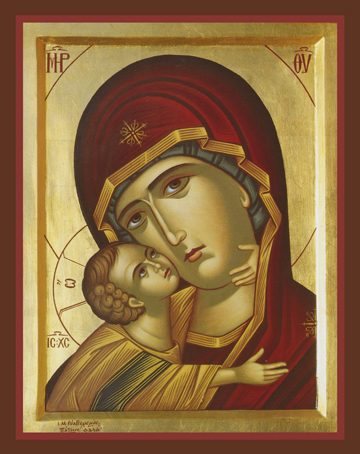
Torrance makes his point well. See, much of theological history in the past millennium has tended to argue that – although it is completely true that Christ assumed all that we are – Christ took on a humanity that in a very real sense was already healed, especially if such humanity was bestowed on him by being birthed from the Mother of God, the Theotokos, whom many theologians consider to have been conceived in an “immaculate” way as well. Well, if the Mother of God holds a humanity which is already cleansed, then what Christ assumes by being born of the Theotokos is a humanity which is foreign to the rest of us, right? This seems, to me, to be an impasse at which a Mariology or Christology which disallows any talk of Christ or Mary holding sinful flesh (not that they themselves are sinful or engage in any sort of sin) contradicts the patristic principle we receive from the historic Church catholic. What do we do about this?
Well, as someone who holds a high reverence for the Theotokos and who even affirms (with the fathers) that she very well can be said to be sinless, I think the way forward for all catholic Christians is to hold to a sort of dual affirmation: that, just as Torrance emphasizes, Christ (and Mary) are completely sinless and spotless but in order to be in step with the Christological principle that “all that is unashamed is unredeemed” we must also say that Christ (and Mary) had corrupted flesh, at least in their earthly, pre-ascension, salvific lives.
Such it seems to me. Torrance ends, saying:
“Christ the Word did not sin. He did not become flesh of our flesh in a sinful way, by sinning in the flesh. If God the Word became flesh, God the Word is the subject of the incarnation, and how could God sin? How could God deny God, be against himself, divest himself of his holiness and purity?… By remaining holy and sinless in our flesh, he condemned sin in the flesh he assumed and judged it by his very sinlessness.”[4]
Our Lord Jesus Christ assumed all that we are in order that we may be all that he is in his restored, redeemed, ascended humanity. We truly do not have a great high priest who is unable to sympathize with our weaknesses.
Soli Deo Gloria
[1] Thomas F. Torrance, Incarnation: The Person and Life of Christ (Downers Grove, IL: InterVarsity Press, 2008), 61.
[2] Thomas F. Torrance, Incarnation: The Person and Life of Christ (Downers Grove, IL: InterVarsity Press, 2008), 62.
[3] Thomas F. Torrance, Incarnation: The Person and Life of Christ (Downers Grove, IL: InterVarsity Press, 2008), 62.
[4] Thomas F. Torrance, Incarnation: The Person and Life of Christ (Downers Grove, IL: InterVarsity Press, 2008), 63.

 Alex Renner's Blog