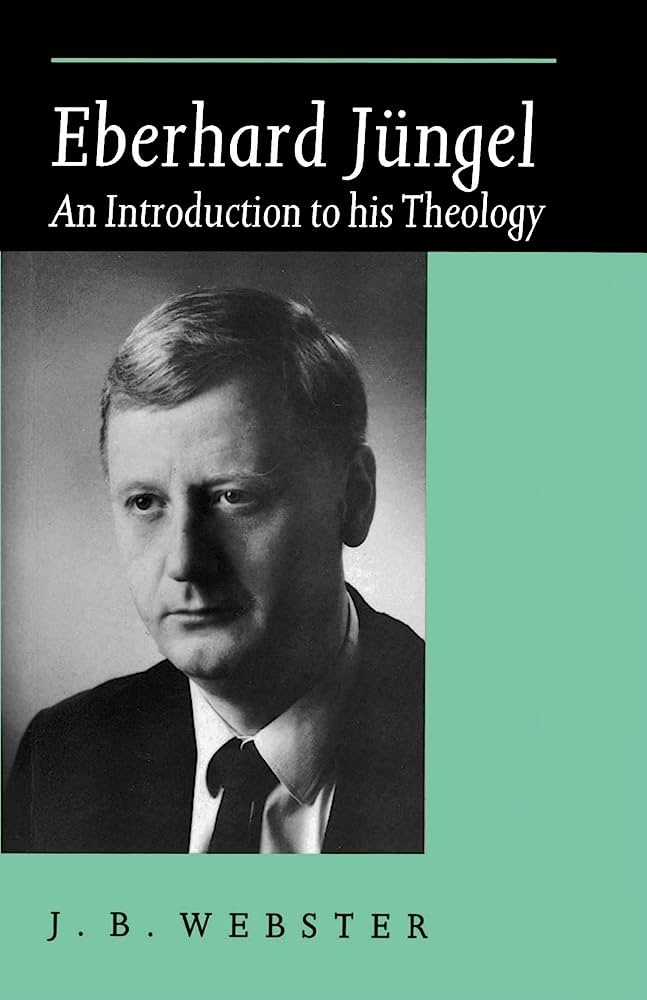
I recently purchased John Webster’s Eberhard Jüngel: An Introduction to his Theology, and have been wildly pleased with what I have found and read there. Amidst my daily perusing of the best anthology of Barth’s work in English today – The Essential Karl Barth by Keith Johnson – I find that reading Webster’s intro on Jüngel is a helpful supplement for illuminating certain points of Barth and for understanding how those after him built upon and developed his theology. Jüngel, in my opinion, functions as a sort of theological son to Barth: he builds upon his good points, elucidates emphases of Barth’s which aren’t totally clear in Barth’s writings, and critiques Barth when he thinks he is in error. I find many aspects of Jüngel’s life and work exciting, too. Both of Jüngel’s mentors, for example, Karl Barth and Martin Heidegger, have inspired much of my own life, language, and thought. Martin Heidegger’s Being and Time, though I have only read portions of it, has solidified certain convictions I was playing around with when meditating on the relationship between human subjectivity, hermeneutics, and theological method. Needless to say, too, Barth’s writings have had a similar yet greater effect on me.
I found much to appreciate in the opening chapters of the book. Webster writes, commenting on a few core ideas of Jüngels’,
“The essence of God is nothing other than the essence of the one who works and reveals… The history of the man Jesus constitutes nothing less than the inner life of God, the very place where God’s trinitarian relatedness is played out before the world… God’s way of being himself is by being God for us. It is this which lies behind the concept of ‘correspondence’ (Entsprechung) which Jüngel uses to describe the inseparability of God’s immanent life from his economic operations. For if God ‘corresponds with himself’ in the event of revelation, then his revealed being pro nobis is nothing other than his immanent being pro se.”[1]
Jüngel emphasizes, then, the same point put forward by Barth, Rahner, and the Nicene theologians, that who we receive by faith in the person of the Lord Jesus Christ is none other than the Eternal Son of the Trinity. If we want to say that the Lord Jesus is truly “in the form of God” (Phil. 2:6) as we meet him by faith, then who God is in His economy (i.e., in Jesus) is who He must be in His ontology (i.e., in His Triune life). If “Rahner’s Rule,” that who God is in His life (i.e., who He really and truly is within Himself) is who He is in His activity or workings towards us, is to be upholded and maintained then we must affirm Jüngel’s point here: “The history of the man Jesus constitutes… the very place where God’s trinitarian relatedness is played out before the world.” The theological implications of this simple formula are tremendous. Furthermore, the statement that “God’s way of being himself is by being God for us” finds deep soil in Barth’s same case: who God has chosen to be in His act of love by uniting Himself with humanity in Jesus Christ is “God-with-humanity.” In other words, God’s incarnation in Jesus is the point at which God chose to forever be united with humanity in intimate union. God will never again be Himself without being God-with-humanity.
Going on to illuminate more of Jüngel’s core ideas, Webster discusses Jüngel’s elucidation of revelation from a different yet similar angle. Jüngel seeks to answer the question, in a truly post-metaphysical vein (with heavy overtones of Heideggerian ontology language): How is it that humans can speak of God “as object”? Jüngel’s contention with “traditional,” metaphysical accounts of God are that they subject God to metaphysical categories foreign to the subject itself (i.e., God) and inevitably treat God as an object to be analyzed. As a theologian of the inductive vein, convinced that theology can only proceed and take its cues from the nature of the divine subject in question rather than from general principles applied to the subject, Jüngel proposes that the only way humans can speak of God’s being-as-object is through the utter and total subjection of theology’s speech about God to the ways in which God has already allowed Himself to be spoken of. Webster includes a quotation I think should be given here in full (from Jüngel’s seminal work God’s Being is in Becoming):
“God’s being-as-object is his being-revealed. God is thus the object of knowledge insofar as he has interpreted himself. And insofar as God has interpreted himself in his revelation and so made himself the object of knowledge of God, he has also made man into the subject of the knowledge of God… That means… that God’s being-as-object is not the result of human objectification of God… He is only objective as the one who has made himself objective.”[2]
Moving on to Jüngel’s position on theological language, which I thought was particularly illuminating, Webster lays out the centrality of the idea of metaphor in the theology of Jüngel. Following Heidegger, Jüngel argues that the literalistic boundaries which Western thought has placed on the conception of truth has stifled theological language and theologians’ understanding of just what can be rightly said concerning God. However, theological language is not therefore transcendent of human speech. Theological language is and can only be decidedly human. Webster comments,
“Jüngel insists that language about God must be authentically human language. Of course, he is firm in the conviction that language about God is only possible on the basis of God’s revelatory utterance, and that such language does not take its rise from within human language since it is demanded of man from beyond the horizons of worldly discourse. But he affirms with equal conviction that language about God is not the suspension of human language or its devaluation. Language about God is certainly not immanent within the structures of ordinary human speech. Yet it does not so transcend those structures as to lose its human character. Language about God is a demand which goes against the grain of man’s natural linguistic resources; yet it is not thereby less but more human than ‘ordinary’ discourse.”[3]
Theological language is human language in the highest and most true sense.
I highly recommend the works of Jüngel, and this small introduction, to you. Along with the rest of the dialectical theologians, Jüngel stands as a voice which points a way forward (albeit imperfectly) for future theological speaking in this post-metaphysical moment.
[1] John Webster, Eberhard Jüngel: An Introduction to his Theology (Cambridge, UK: Cambridge University Press), 17-18.
[2] Eberhard Jüngel, The Doctrine of the Trinity: God’s Being is in Becoming (Edinburgh: T&T Clark, 2014), 57.
[3] John Webster, Eberhard Jüngel: An Introduction to his Theology (Cambridge, UK: Cambridge University Press), 40.

 Alex Renner's Blog